
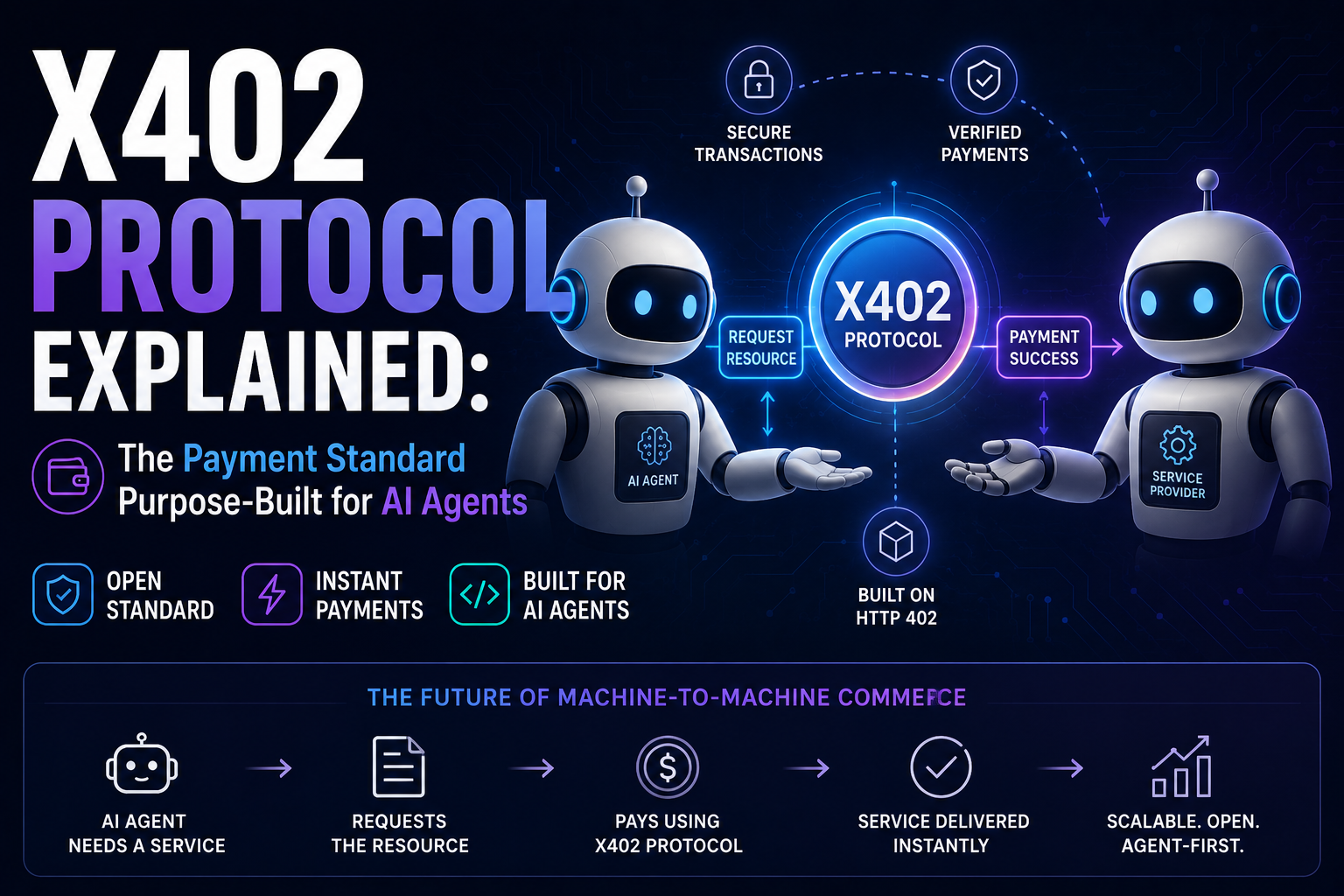
x402 Protocol Explained: The Payment Standard Purpose-Built for AI Agents
Published: May 17, 2026 | Reading time: 15 minutes | Category: AI Agents, Payments, Agentic Economy
There’s a new payment protocol quietly becoming the backbone of the AI agent economy — and most people have never heard of it.
It’s called x402. It was built by Coinbase, adopted by AWS on May 7, 2026, and it’s now backed by 22 founding organizations including Google, Microsoft, Visa, Mastercard, Stripe, Shopify, and Cloudflare. By late April 2026, it had already processed 165 million transactions worth roughly $50 million in cumulative volume — powered by 69,000 active AI agents.
And the search term “x402 protocol” barely existed six weeks ago.
This guide is the plain-English explainer the keyword deserves. No blockchain background required. By the end, you’ll understand what x402 is, why it was necessary, how it works step-by-step, what the x402 Bazaar is, who’s adopting it, and whether it will become the default payment standard for AI agents everywhere.
Why AI Agents Needed Their Own Payment Protocol
To understand why x402 exists, you need to understand the fundamental problem it solves.
AI agents are getting remarkably capable. They can research, reason, browse, draft, schedule, and coordinate complex multi-step tasks without human supervision. But the moment an agent needs to pay for something in the middle of a task — a premium API, a paywalled article, a per-call data feed — the entire autonomous workflow breaks down.
Here’s what that breakdown looked like before x402:
The old world (pre-x402): An agent tasked with financial research needs real-time market data from a paid provider. To access it, a human has to: create an account with the data provider, enter payment information, generate an API key, securely store that key somewhere the agent can access it, manage monthly billing, and pre-configure the agent to use that specific provider. That’s a manual process that could take hours — and it had to be repeated for every paid service the agent might ever need.
This is the core problem. Traditional payment flows — filling out forms, creating accounts, generating API keys, managing subscriptions — were designed for humans with browsers. They assume a person with a credit card is on the other end. An AI agent running inside a server at 3am has no browser, no ability to fill a form, and no way to establish a billing relationship on the fly.
The AI agent economy is built on the assumption of autonomy. But payments kept inserting a human back into the loop. Every API worth calling was either free or required manual setup. That meant either building with inferior free data, or doing expensive upfront configuration that locked agents into pre-approved services.
As Coinbase framed it: “Filling out a form is a human behavior that doesn’t match the programmatic nature of the internet. It’s time for an open, internet-native form of payments.”
x402 is that payment form — native to the internet, designed for machines, and compatible with every HTTP-based system on the planet.
What x402 Actually Is — and What HTTP 402 Has to Do With It
Let’s start with the formal definition, then make it human.
x402 is an open, HTTP-native payment standard that lets any client — an AI agent, a developer’s script, an automated workflow — pay for any web resource or API within the same HTTP request-response cycle it uses to request that resource. It requires no accounts, no subscriptions, and no API keys by default. Payment is embedded directly in the protocol.
The name “x402” comes directly from the HTTP status code it’s built on: 402 Payment Required.
The 1996 Status Code That Just Got Switched On
In the early days of the web, engineers designing the HTTP standard were thinking ahead. They knew the internet would eventually need a way for servers to charge for content. So they reserved HTTP status code 402 — “Payment Required” — as a placeholder for future payment functionality.
But in 1996, there was no practical way to make internet micropayments work. Credit card infrastructure was too slow and expensive for small transactions. Crypto didn’t exist. So 402 sat in the standard — officially defined, never implemented — for nearly three decades.
As one technical reference put it: “Defined in 1999, reserved ‘for future use,’ and ignored for a quarter century.”
In May 2025, Coinbase took that dormant status code and gave it a working implementation. They called it x402 — and by attaching a USDC stablecoin payment rail to HTTP 402, they created the first practical internet-native payment protocol that works for machines as naturally as a GET request works for fetching a webpage.
The x402 Foundation, co-founded with Cloudflare, was announced in September 2025 and formalized under the Linux Foundation in April 2026 — with 22 founding member organizations including AWS, Google, Microsoft, Visa, Mastercard, Stripe, Shopify, American Express, Adyen, and the Solana Foundation.
This is not a startup experiment. This is fast becoming infrastructure.
How x402 Payments Work in an Agent’s Reasoning Loop
Here’s the technical flow made simple. Every x402 payment follows four steps, and the entire cycle — from request to resource delivery — completes in under two seconds.
Step 1: The agent makes a normal HTTP request. An AI agent calls an API endpoint the same way it would call any other API. It doesn’t know in advance whether the endpoint is paid or free. It just sends a GET or POST request.
Step 2: The server returns HTTP 402 with payment terms. If the resource requires payment, the server responds with an HTTP 402 status code — “Payment Required” — along with machine-readable payment instructions embedded in the response header. These instructions specify: the price, the accepted token (usually USDC), the blockchain network (Base or Solana), and the recipient wallet address.
Step 3: The agent signs a payment and retries. The agent reads the payment terms, evaluates the cost against its budget, and signs a USDC payment authorization. It resubmits the original request with a cryptographic payment proof attached as an HTTP header (the X-PAYMENT header). No human interaction required. This all happens inside the agent’s existing reasoning loop without pausing or interrupting the task.
Step 4: The facilitator verifies. The server delivers. A lightweight middleware component called a facilitator verifies that the payment settled on-chain. Once confirmed, the server delivers the resource. The agent receives the data and continues its task.
Transaction cost on Base: approximately $0.0001. Settlement time: approximately 200 milliseconds.
No accounts created. No API keys generated. No invoices. No credit card forms. No payment processor taking 2.9% plus 30 cents per transaction. The protocol itself charges zero fees. The only cost is the blockchain gas fee, which on Base or Solana is a fraction of a cent.
What a Facilitator Does (And Why It Matters)
The facilitator is worth understanding because it’s what makes x402 practical at scale. Sellers of paid APIs and data don’t want to maintain their own blockchain infrastructure — monitoring the chain, verifying transaction confirmations, handling edge cases. The facilitator handles all of that.
Coinbase’s CDP Facilitator handles payment verification and settlement so sellers don’t need to maintain their own blockchain infrastructure. It processes payments on Base, Polygon, Arbitrum, World, and Solana, with a free tier of 1,000 transactions per month and $0.001 per transaction after that.
Crucially, the facilitator model is open. Anyone can run their own facilitator for custom settlement logic, alternative chains, or specialized compliance. x402 is not locked to Coinbase’s infrastructure — Coinbase just operates the most mature facilitator at the moment.
x402 vs. Traditional API Billing: The Key Differences
To really understand why x402 matters, it helps to see it side by side with the old way of paying for APIs.
| Traditional API Billing | x402 | |
|---|---|---|
| Setup required | Account creation, API keys, billing config | None |
| Payment timing | Monthly subscription or manual top-up | Real-time, per-request |
| Minimum transaction | Typically $1+ (card fees make less uneconomical) | Fractions of a cent |
| Human in the loop | Required for setup; often for payment approval | Zero |
| Works for agents | Only with pre-provisioned credentials | Natively |
| Service discovery | Requires developer to know & configure each service | Agents can discover services at runtime |
| Settlement speed | Days (bank) to seconds (card) | ~200ms |
| Protocol fee | 2.9% + $0.30 (typical card) | $0.0001 gas fee |
| New service access | Weeks of integration work | Instant (if x402-compatible) |
The last row is the one that changes everything for autonomous agents. With traditional billing, adding a new paid data source to an agent’s repertoire requires a developer to: negotiate access, create an account, manage credentials, write integration code, and test the connection. That’s weeks of work per provider.
With x402, an agent can discover a new paid service at runtime, evaluate the price, pay for exactly one call, and use the result — all without any developer intervention. The service marketplace expands from “whatever was pre-configured” to “anything on the x402 network.”
That’s the qualitative shift. It’s not just cheaper or faster. It changes what kinds of agents are possible.
The x402 Bazaar: 10,000 Endpoints Agents Can Pay For Today
The x402 Bazaar is x402’s discovery layer — and it’s one of the most underappreciated parts of the ecosystem.
Think of the Bazaar as a marketplace where AI agents can browse, search, and purchase access to paid services they’ve never been pre-configured to use. The Coinbase x402 Bazaar MCP server is available through AgentCore Gateway, providing over 10,000 x402 endpoints that agents can search, discover, and pay for autonomously.
The Bazaar exposes two tools through a Model Context Protocol (MCP) server:
search_resources — An agent calls this tool with a natural language query (e.g., “real-time financial data” or “web scraping API”). The Bazaar returns matching services with their pricing, input/output schemas, and relevance-ranked results. The agent can read these results and decide which service best fits its task.
proxy_tool_call — Once an agent selects a resource, it calls this tool to use it. The x402 client handles the 402 detection, payment creation, and retry automatically. From the agent’s perspective, it’s a single function call. The payment happens invisibly underneath.
What’s Available in the Bazaar Right Now
The early catalog skews toward categories where per-request pricing is a natural fit:
- Financial and market data — Real-time price feeds, earnings data, sentiment analysis, crypto analytics (Messari, Token Metrics)
- Web data and scraping — Structured extraction from any URL, rendered screenshots, PDF conversion, search results (Browserbase, Exa, Simplescraper)
- Social data — Farcaster API queries, X/Twitter post access, influencer metrics (Neynar)
- AI inference — Pay-per-prompt wrappers around model APIs, GPU compute access (Hyperbolic)
- Research and news — Paywalled articles, industry reports, web search at per-call pricing
- Identity and verification — Company lookup, email verification, domain intelligence
The Bazaar supports semantic search (HTTP and MCP), structured filters, and quality-based ranking — so agents can identify the best-fit service for a task rather than browsing a flat catalog.
For developers building APIs and data products: listing in the Bazaar means AI agents can discover and purchase access to your service without you ever marketing to them directly. The x402 Bazaar is effectively a B2B marketplace where the buyers are machines.
Who Is Adopting x402 Right Now? (AWS, Coinbase, Stripe, and More)
x402 has moved from a Coinbase-led experiment to a multi-stakeholder standard remarkably fast. Here’s a snapshot of the major adopters as of May 2026:
AWS (Amazon Bedrock AgentCore)
The biggest enterprise signal yet. AWS launched Amazon Bedrock AgentCore Payments on May 7, 2026 — built natively on x402. AWS also joined the x402 Foundation as a member. The AgentCore integration makes x402 the default payment rail for AI agents built on one of the world’s largest cloud platforms. Early adopters include Warner Bros. Discovery, Cox Automotive, Thomson Reuters, PGA TOUR, and Heurist AI.
Coinbase
The protocol’s inventor. Coinbase operates the primary x402 facilitator (CDP), published TypeScript, Python, and Go SDKs, and maintains the Bazaar discovery layer. Coinbase’s AgentKit gives developers a toolkit for building autonomous agents that can transact on-chain using x402.
Stripe
Stripe shipped x402 support in February 2026 through its Machine Payments product, supporting USDC on Base. Stripe also contributed wallet infrastructure to the AgentCore Payments launch through its Privy subsidiary. Stripe’s positioning reflects its stated intent to build economic infrastructure for AI systems.
Cloudflare
Co-founded the x402 Foundation with Coinbase in September 2025. Cloudflare built native x402 support into Cloudflare Workers — meaning any developer deploying serverless functions on Cloudflare (which handles a large percentage of all internet traffic) can add x402 payment gates with minimal code.
Google’s Agent Payments Protocol (AP2) uses x402 for on-chain settlement. Google Cloud has published native x402 integration guides. Google is also an x402 Foundation member.
Visa and Mastercard
Both card networks joined the x402 Foundation. Visa launched “Agentic Ready” — an initiative for AI agent payment standards. Visa added x402 support through its Trusted Agent Protocol (TAP). Mastercard joined as a founding member. The participation of traditional card networks signals that x402 is being treated as infrastructure, not competition.
World (formerly Worldcoin)
World launched AgentKit in March 2026, integrating x402 to enable human-verified AI agents to make autonomous payments. The integration uses World ID to prove there is a real person behind every AI transaction — addressing a key enterprise concern about authorization accountability in agent commerce.
The Numbers at Launch
By late April 2026, the x402 protocol had processed 165 million transactions with roughly $50 million in cumulative volume, with 69,000 active agents using the network. The average transaction value sits near $0.30 — squarely in the API metering range the protocol was designed for.
Will x402 Become the Universal Agent Payment Standard?
This is the honest question. x402 has strong momentum, powerful backers, and a 30-year head start baked into the HTTP spec itself. But the agent payment protocol landscape in 2026 is genuinely contested.
Here are the main competing approaches:
Stripe Machine Payments Protocol (MPP): Launched March 18, 2026 with Tempo. Session-based streaming payments with Stripe’s compliance stack built in. Collaborators include Anthropic, OpenAI, DoorDash, Mastercard, Nubank, Ramp, Revolut, Shopify, Standard Chartered, and Visa.
Google Agent Payments Protocol (AP2): Uses cryptographically signed “Mandates” — user-delegated spending authority with fine-grained controls. Focused on authorization traceability. Better for consumer-facing agent transactions where accountability matters.
Visa Trusted Agent Protocol (TAP): Visa’s own standard for agent transactions, designed to connect agent commerce to traditional card rails.
Each protocol solves a different part of the payment problem:
- x402 is optimized for machine-to-machine micropayments — API calls, data feeds, sub-dollar transactions where speed and zero friction are paramount
- MPP is better for session-based flows — where an agent runs a longer task with a streaming payment model
- AP2 is better for high-value transactions where you need cryptographic proof of user authorization
A practical agentic payment stack in 2026 often looks like: MCP for tool discovery → x402 for sub-dollar API micropayments → AP2 or TAP for larger, user-authorized transactions.
In other words: x402 is not trying to be the only standard. It’s trying to be the best standard for the transaction type that AI agents will execute at the highest volume — fractions of a cent, millions of times per day, fully autonomous.
The Case That x402 Wins
Three structural advantages make x402 the most likely winner in the micropayment lane:
1. It’s built into HTTP. Every web server and every HTTP client already speaks the language. x402 doesn’t require new infrastructure — it activates a status code that’s been dormant for 30 years. The addressable market is literally the entire internet.
2. It has the right backers for developer adoption. The agent economy is being built by software engineers who trust Coinbase and Stripe — not by procurement teams who trust Visa and Mastercard. Winning developer adoption early means winning the ecosystems those developers build.
3. It’s genuinely neutral. Governance moved to the Linux Foundation in April 2026. Coinbase contributed the protocol but does not control it. The spec is open, the facilitator model is open, and the foundation membership spans competitors — Visa and Mastercard both joined alongside Coinbase and Stripe. This neutrality removes the adoption blocker that kills proprietary standards.
The Honest Risks
Crypto friction. Production x402 currently settles in USDC on Base or Solana. For non-crypto-native businesses, wallet management and key security add a real learning curve. Managed wallet solutions from Coinbase and Stripe are closing this gap, but it’s not closed yet.
Very early volume. $50 million in cumulative volume sounds significant, but against global card volumes it’s a rounding error. The real commercial inflection point — when average transaction values rise from $0.30 into the dollars — hasn’t arrived yet.
No chargebacks. x402 is closer to cash than cards. There are no network-level reversals. Refunds require the merchant to send a compensating transfer manually. For high-value consumer flows, this is a real limitation. For API micropayments between machines, it’s actually a feature — no chargebacks on a $0.001 API call is precisely what you want.
The IMF raised a related concern in an April 2026 note on agentic AI in payments: payment systems rely on deterministic rules, while agentic AI systems use probabilistic decision-making. Authorization traceability and legal liability for agent-initiated payments remain unresolved at the regulatory level.
The Bottom Line
x402 is not a cryptocurrency story. It’s an infrastructure story.
The HTTP 402 status code was reserved in 1996 because the web’s designers knew payments would eventually need to be native to the protocol. It took 30 years for the technology to catch up — stablecoins that settle in milliseconds for fractions of a cent, AI agents that can autonomously execute complex financial decisions, and a protocol that glues the two together.
The bet x402 is making is straightforward: AI agents are becoming economic actors, and they need money that moves at software speed. The institutions backing x402 — AWS, Google, Microsoft, Visa, Mastercard, Stripe, Shopify, Cloudflare — are not making that bet naively.
“There will soon be more AI agents transacting than humans, and they need money that’s built for the internet — programmable, always on, and global.” That’s Brian Foster of Coinbase. Whether you agree with the timeline or not, the direction is clear.
x402 is the protocol built for that world. The window to be early is right now.
Frequently Asked Questions
What does “x402” stand for? The name is a direct reference to HTTP status code 402 — “Payment Required.” The “x” prefix signals it’s an extended implementation of that reserved code. The protocol takes the dormant 402 status and gives it a working stablecoin payment rail.
Do you need to know crypto to use x402? As an end user of an x402-powered product: no. The USDC settlement happens invisibly. You set a budget in dollars; the system handles the rest. For developers building x402-compatible APIs: yes, some familiarity with wallets, stablecoins, and the Base or Solana networks is needed — though managed wallet solutions from Coinbase and Stripe are lowering that bar significantly.
What is USDC and why does x402 use it? USDC is a stablecoin issued by Circle, pegged 1:1 to the US dollar. It’s backed by cash and US Treasury bonds — not volatile like Bitcoin. x402 uses it because traditional payment rails (cards, ACH) charge fixed per-transaction fees that make sub-cent payments economically impossible. USDC on Base settles in 200ms for $0.0001. That’s the price range x402 is designed for.
Who controls x402? Is it Coinbase’s protocol? It was created by Coinbase, but governance moved to the x402 Foundation under the Linux Foundation in April 2026. Coinbase contributed the protocol and does not control its evolution. The foundation has 22 member organizations including competitors like Google, Microsoft, Visa, and Mastercard.
What’s the x402 Bazaar? The x402 Bazaar is a discovery marketplace where AI agents can search for, find, and pay for x402-compatible services at runtime — without developers pre-configuring each integration. The Bazaar MCP server integrated into AWS AgentCore provides over 10,000 endpoints.
How is x402 different from Stripe’s Machine Payments Protocol (MPP)? x402 is optimized for instant, sub-dollar micropayments between machines (API calls, data feeds). Stripe’s MPP is better for session-based, higher-value flows where Stripe’s compliance stack and fiat integration matter. Many agent payment stacks use both: x402 for API-layer micropayments, MPP or AP2 for larger user-authorized transactions.
Where can I start building with x402? The official protocol documentation is at x402.org. Coinbase’s developer documentation is at docs.cdp.coinbase.com/x402. The GitHub repository at github.com/coinbase/x402 has TypeScript, Python, and Go SDKs plus framework adapters for Express, Fastify, Next.js, and Axios. You can explore live x402 endpoints at x402scan.com.
This article is for informational purposes only. Protocol statistics reflect figures reported by the x402 Foundation and Coinbase as of late April and May 2026. All figures are subject to change as the protocol scales.
