
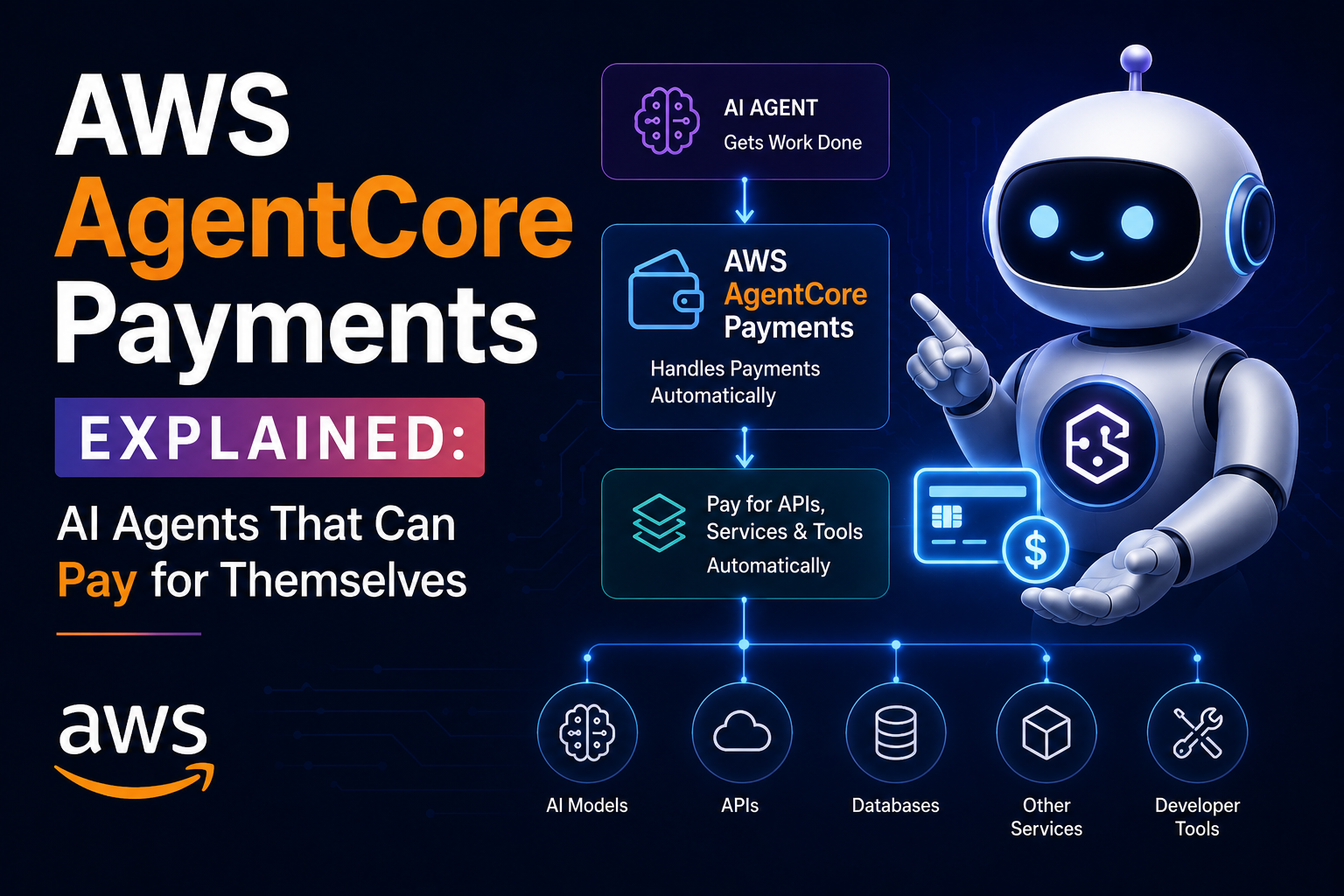
AWS AgentCore Payments Explained: AI Agents That Can Pay for Themselves
Something quietly historic happened on May 7, 2026.
Amazon Web Services launched a feature that lets AI agents spend money. On their own. In real time. Without asking a human first.
It’s called Amazon Bedrock AgentCore Payments, and if you’ve heard the name but couldn’t explain it at a dinner table — this article is for you. No blockchain PhD required. No AWS certifications needed. Just a plain-English walkthrough of what launched, why it matters, and what an AI agent can now buy on your behalf.
What Just Happened: The May 7 Announcement in Plain English
Until last week, AI agents had a fundamental limitation: they couldn’t pay for anything.
An agent could research your competitors, draft your emails, schedule your meetings — but the moment it needed to access a paid API, pull a paywalled article, or call a premium data service, it stopped dead. Either a human had to step in and manually authorize the transaction, or developers had to pre-register and hard-code every paid service the agent might ever use. That’s slow, expensive, and it breaks the whole idea of autonomous AI.
AWS just fixed that.
On May 7, AWS announced Amazon Bedrock AgentCore Payments — built in partnership with Coinbase and Stripe — a system that gives AI agents a wallet, a payment rail, and a spending limit, so they can pay for what they need in the middle of a task, without ever pausing to ask for permission.
Here’s the concrete version of what that means: imagine you’ve built a research agent on AWS Bedrock. You tell it to compile a competitive analysis on three companies. It needs real-time financial data from a paid data provider, an industry report from a paywalled source, and web browsing credits from a service that charges per search. In the old world, you’d need subscriptions to all three before the agent started. In the new world, the agent encounters each paid resource, pays for it automatically in fractions of a cent per call, and keeps going — all within its single execution loop, all within the budget you set.
The first version of AgentCore Payments focuses on stablecoin micropayments for APIs, data feeds and paywalled content, with plans to expand to larger transactions such as hotel bookings, travel reservations and merchant payments.
Early adopters confirmed in the launch material include Warner Bros. Discovery, Cox Automotive, Thomson Reuters, PGA TOUR, and Heurist AI.
The currency powering all of this is USDC — a stablecoin pegged 1:1 to the US dollar. Not volatile crypto. Not Bitcoin. A digital dollar that settles in milliseconds.
What Is the x402 Protocol and Why Does It Matter?
To understand AgentCore Payments, you need to understand the protocol underneath it: x402.
The HTTP 402 Status Code That Sat Dormant Since 1996
If you’ve ever seen a “404 Not Found” error in your browser, you’ve seen an HTTP status code. These are standardized signals that servers send to clients to describe what’s happening with a request.
Back when the original HTTP standard was written in the 1990s, the engineers included a status code called 402 Payment Required. The idea was logical: websites would eventually charge for content, and servers would need a standard way to say “this costs money before I’ll show it to you.”
But in 1996, there was no practical way to make internet payments work, so 402 was shelved. Defined in 1999, reserved “for future use,” and ignored for a quarter century.
In 2025, Coinbase and Cloudflare effectively “activated” this missing element, giving it a form and technological framework compatible with modern blockchains. They called it x402.
How x402 Works (In Plain English)
x402 turns HTTP 402 into a working payment system for machines. Here’s the flow:
- An AI agent makes a request to a paid API or data endpoint
- The server responds with a 402 Payment Required signal, along with machine-readable payment terms: the price, the accepted stablecoin, the payment address
- The agent evaluates the cost against its budget, executes a USDC payment on-chain, and attaches a payment receipt
- It resubmits the original request with proof of payment
- The server verifies the payment and delivers the content
This all happens within a single automated exchange, with sub-2-second settlement and transaction costs of approximately $0.0001.
No subscriptions. No API keys pre-registered by a human. No billing accounts. The agent discovers the price, pays it, and moves on — all without leaving its reasoning loop.
The x402 protocol is governed by the x402 Foundation, which moved under the Linux Foundation in April 2026. Founding members include Stripe, Cloudflare, Shopify, and Solana, with backing from AWS, Google, Microsoft, Visa, and Mastercard. Coinbase open-sourced x402 in May 2025.
By late April 2026, the protocol had reached 69,000 active agents, 165 million transactions, and roughly $50 million in cumulative volume, according to Coinbase. The average transaction value sits near $0.30, calibrated for API metering rather than retail purchases.
This is not a niche crypto experiment. This is a protocol backed by the biggest names in both tech and finance, already processing real transactions at scale.
How AgentCore Payments Actually Works Step-by-Step
Now that you understand x402, here’s exactly how AgentCore Payments layers on top of it for AWS developers:
Step 1 — Connect a wallet. The developer connects either a Coinbase CDP wallet or a Stripe Privy wallet to their AgentCore setup. This is the agent’s “bank account.” It holds USDC. It can be funded with stablecoins or fiat via debit card.
Step 2 — Set a session spending limit. Before the agent starts any task, the developer (or end user) defines a budget ceiling. This is enforced at the infrastructure layer — it’s not advisory, it’s a hard limit. The agent cannot spend more than this amount in a session, period.
Step 3 — The agent runs its task. The agent begins executing — researching, calling APIs, browsing, reasoning. It operates just like any normal Bedrock agent.
Step 4 — It hits a paid endpoint. The agent requests a resource. The server returns an HTTP 402 with payment terms.
Step 5 — AgentCore handles the payment automatically. When an agent encounters a paid resource and receives an HTTP 402 response, AgentCore handles the x402 protocol negotiation, wallet authentication, stablecoin payment, and proof delivery back to the endpoint, all without interrupting the agent’s reasoning loop.
Step 6 — The agent receives the content and continues. No pause. No human approval. The task keeps running.
Step 7 — Full audit trail. Every transaction is observable through the same logs, metrics, and traces developers already use in AgentCore. Nothing is hidden. Every payment is recorded.
And there’s one more piece worth highlighting: the x402 Bazaar. The Coinbase x402 Bazaar MCP server is available through AgentCore Gateway. The Bazaar provides a curated list of x402 endpoints that agents can search, discover, and pay for when relevant to their task — turning paid services into something agents can find and use on their own rather than requiring developers to hardcode each integration.
In other words: agents can now discover what’s available to buy, not just pay for things developers pre-approved. That’s a meaningful leap.
Coinbase Wallet vs. Stripe Privy: Which Should You Use?
AgentCore Payments supports two wallet options at launch. Here’s how to think about the choice:
Coinbase CDP Wallet
The Coinbase Developer Platform (CDP) Wallet is Coinbase’s native developer wallet infrastructure. It’s built for the x402 ecosystem from the ground up, since Coinbase is both the inventor of x402 and a founding member of the x402 Foundation.
Best for:
- Developers already building on Coinbase infrastructure
- Teams that want maximum native x402 compatibility
- Agents that will primarily transact on the Base blockchain network (Coinbase’s own L2)
- Businesses comfortable with crypto-native tooling
What it offers: Native USDC settlement on Base, direct access to the x402 Bazaar’s full catalog of discoverable endpoints, Coinbase’s compliance and KYC infrastructure.
Stripe Privy Wallet
Privy is Stripe’s wallet infrastructure subsidiary, acquired to enable Stripe’s push into the AI payments space. Stripe has publicly stated its intent to build economic infrastructure for AI systems, and Privy is its implementation.
Best for:
- Teams already on the Stripe ecosystem (extremely common for US businesses)
- Developers who want the most familiar, developer-friendly wallet experience
- Businesses that need fiat on-ramp support (funding the wallet via debit card, not just crypto)
- Enterprises that need Stripe’s compliance relationships for regulatory comfort
What it offers: USDC settlement on both Base and Solana, fiat funding via debit card, Stripe’s developer experience, enterprise compliance support.
The Short Answer
If you’re crypto-native or want deepest x402 ecosystem access: Coinbase CDP. If you’re an existing Stripe user or building for a non-crypto-native audience: Stripe Privy. Both settle in USDC, both work with AgentCore, and both are covered by the same spending guardrails.
Settlement on the Base network in USDC takes approximately 200 milliseconds, at a fraction of a cent per transaction. Whichever wallet you choose, the payment experience for the end user is invisible.
Real Use Cases: What AI Agents Can Now Buy on Their Own
This is where it gets tangible. Here are real examples of what agents can autonomously pay for using AgentCore Payments today — and what’s coming:
What Agents Can Buy Right Now
Premium API access. An agent researching a market can pay per-call for financial data APIs (like Messari or Exa) rather than requiring a developer to pre-register a subscription. It pays exactly for what it uses, nothing more.
Paywalled content. A competitive intelligence agent can access individual paywalled articles or reports — paying fractions of a cent per article — without a blanket subscription to every publication that might be relevant.
Compute and AI inference. Agents can purchase compute credits or model inference from third-party AI providers on demand, paying only when they need extra processing power for a specific task.
MCP server access. Through the Coinbase MCP integration in AgentCore Gateway, agents can connect to thousands of x402-compatible services, including data and research providers such as Exa, Messari, and Browserbase, and pay for them at runtime, without requiring prior configuration.
Real-world use case — Heurist AI: Heurist AI is building a research agent that performs financial analysis using the payments capability. “End customers can set a budget for the research and the agent uses AgentCore payments to get accurate real-time data,” said JW Wang, founder of Heurist AI.
Real-world use case — Warner Bros. Discovery: The media giant is actively exploring AgentCore Payments for agent-driven commerce around premium content — envision an agent that can autonomously purchase access to a live sports stream or a premium entertainment release on behalf of a viewer, triggered by a context cue rather than a manual checkout.
What’s Coming Next
AWS has publicly stated that micropayments are only the first phase. Future expansion targets include:
- Hotel and travel bookings — agents completing full travel arrangements including payment
- Merchant payments — agents purchasing physical goods or services
- Agent-to-agent transactions — one AI agent paying another AI agent for specialized services, creating a machine-to-machine economy
The services that support them must be priced and consumed in that way: fractions of a cent per call, billed in real time. Early protocols like x402, ACP, MPP, and AP2 are pioneering what this looks like, and teams are experimenting with payment-enabled agents.
Spending Guardrails: How AWS Stops Agents from Going Rogue
The obvious question when you tell people “AI agents can now spend money autonomously” is: what stops them from spending everything?
The answer is a layered guardrail system built directly into AgentCore’s infrastructure. This isn’t optional — it’s the foundation the entire system runs on.
Session-Level Spending Limits
Every agent session has a hard budget cap set by the developer or end user before the agent starts. This is enforced at the infrastructure layer, not in the agent’s code. The agent cannot exceed it regardless of what logic it’s running. If it hits the ceiling mid-task, the payment is rejected and the agent stops spending — it doesn’t ask for more.
Per-Transaction Authorization
Rather than giving the agent open-ended access to a wallet, AgentCore requires explicit authorization for each payment type and price range. An agent configured to pay up to $0.10 per API call cannot approve a $5.00 transaction, even if the source code allows it.
Full Transaction Observability
Spending limits are enforced deterministically at the infrastructure layer, and every transaction is observable through the same logs, metrics, and traces developers already use in AgentCore. This means finance and compliance teams can audit exactly what the agent spent, when, on what, and whether it stayed within policy — the same way they’d audit any other cloud resource.
Policy-Based Controls
For enterprise deployments, AgentCore supports policy-based spending controls: rules that restrict which endpoints an agent can pay for, which payment amounts are permissible, and which wallet types are allowed for which agent types. An agent handling customer service can be restricted from purchasing data products a research agent would have access to.
Why USDC (Not a Credit Card)
The choice of USDC over traditional payment methods isn’t arbitrary. Credit cards weren’t designed for sub-cent micropayments — the per-transaction fee on a $0.001 purchase would exceed the purchase itself. Stripe and Coinbase reported that the system is optimized for transactions under a dollar, often “fractions of a cent” per call. That is exactly the price band traditional payment rails refuse to serve because the per-transaction fees would exceed the purchase itself.
USDC solves this. It settles in milliseconds, costs fractions of a cent to transact, is programmable, and can be funded with regular US dollars from a debit card. For end users, it doesn’t feel like crypto at all.
What This Means for the Agentic Economy in 2026
Step back from the technical details for a moment and consider what this actually represents.
For the last several years, the conversation about agentic AI has been about capability — what can agents reason about, what tasks can they complete, how well do they handle complex multi-step workflows. AgentCore Payments shifts the conversation to economic agency. Agents aren’t just workers that think. They’re now economic actors that spend.
Brian Foster, head of infrastructure growth and strategy at Coinbase, framed it bluntly: “There will soon be more AI agents transacting than humans, and they need money that’s built for the internet, programmable, always on, and global.”
That’s not a marketing line. That’s a prediction about the structure of the global economy — and AWS just built the infrastructure to make it possible.
Here’s what the downstream effects look like across different parts of the tech and business ecosystem:
For developers: You no longer need to pre-register subscriptions for every API your agent might use. You set a budget, point your agent at a task, and it acquires what it needs at runtime. This dramatically reduces the upfront setup cost for agentic applications.
For data and API providers: There’s now a monetization channel that didn’t exist before — pay-per-agent-call, at sub-cent prices, without requiring that every customer go through a manual account setup. The x402 Bazaar is effectively a marketplace where your API can be discovered and purchased by AI agents you’ve never marketed to.
For businesses deploying agents: The ROI calculation on agentic AI just changed. An agent that can acquire the data it needs to complete a task — without human intervention to unlock each data source — becomes dramatically more autonomous and therefore more valuable.
For the broader economy: The system is part of a broader push to enable an “agentic economy” in which AI agents act as independent economic actors for users. This is the infrastructure layer that makes that economy real — not theoretical.
What’s Still Early
It’s important to be clear: AgentCore Payments launched in preview. The x402 ecosystem, while growing fast, is still early-stage. The catalog of x402-compatible endpoints is limited compared to what traditional APIs offer. Large-transaction use cases (hotel bookings, merchant payments) are on the roadmap, not live.
The window to be early here — as a developer building x402-compatible APIs, as a business deploying payment-enabled agents, as a publisher enabling per-article agent purchases — is open right now. The infrastructure is shipping. The demand is building. The protocols are stabilizing.
As Coinbase’s Coinbase put it in the launch announcement: “By bringing Coinbase’s stablecoin infrastructure and x402 into AWS AgentCore, we’re giving developers the full stack to build agents that move money at software speed, with the trust and compliance enterprises expect.”
The agentic economy doesn’t start when agents can think. It starts when they can pay.
Frequently Asked Questions
Is AgentCore Payments available to all AWS customers? It launched in preview on May 7, 2026. Preview means it’s available to developers who opt in, but it’s not yet generally available for all production workloads. Expect broader availability in the months ahead.
Do I need to understand crypto to use this? No. From an end-user perspective, you fund the wallet with US dollars via debit card and set a budget. The USDC and blockchain settlement happen behind the scenes. You see a dollar amount, not a crypto amount.
What is USDC and is it safe? USDC is a stablecoin issued by Circle, pegged 1:1 to the US dollar. It’s backed by cash and US Treasury bonds. It’s not volatile like Bitcoin. $1 of USDC is always worth $1. It’s one of the most widely used stablecoins globally, with over $60 billion in circulation.
What happens if an agent overspends? It can’t. Session-level spending limits are enforced at the infrastructure layer before any transaction is processed. The agent cannot exceed the budget you set, regardless of what its code instructs.
Can agents pay other agents? Not yet in the first release, but agent-to-agent transactions are explicitly on the roadmap. The x402 protocol is designed to support machine-to-machine commerce, and AWS has signaled this as a future capability.
Which chains are supported? At launch: Base (Coinbase’s L2 network) and Solana. Additional networks are on the roadmap.
What if I’m not on AWS? The x402 protocol itself is open and platform-agnostic. It works with any HTTP-capable agent framework including LangChain, CrewAI, and AutoGen. AgentCore is AWS’s managed implementation, but developers on other platforms can implement x402 directly using open-source tooling.
Where can I get started? The AWS announcement blog at aws.amazon.com/blogs/machine-learning is the authoritative starting point. The x402 Foundation at x402.org provides protocol documentation. The Coinbase Developer Platform has SDKs and wallet setup guides.
Tags: AWS AgentCore payments, Amazon Bedrock AgentCore, what is AgentCore payments, AI agents stablecoin payments, x402 protocol explained, AWS AI agent wallet, AgentCore Coinbase Stripe, AI agents pay for APIs, agentic economy explained, AI agent micropayments 2026, USDC AI agents, x402 foundation.
This article is for informational purposes only and does not constitute financial or investment advice. All product features described reflect the preview launch state as of May 7, 2026, and may change as the product reaches general availability.
