
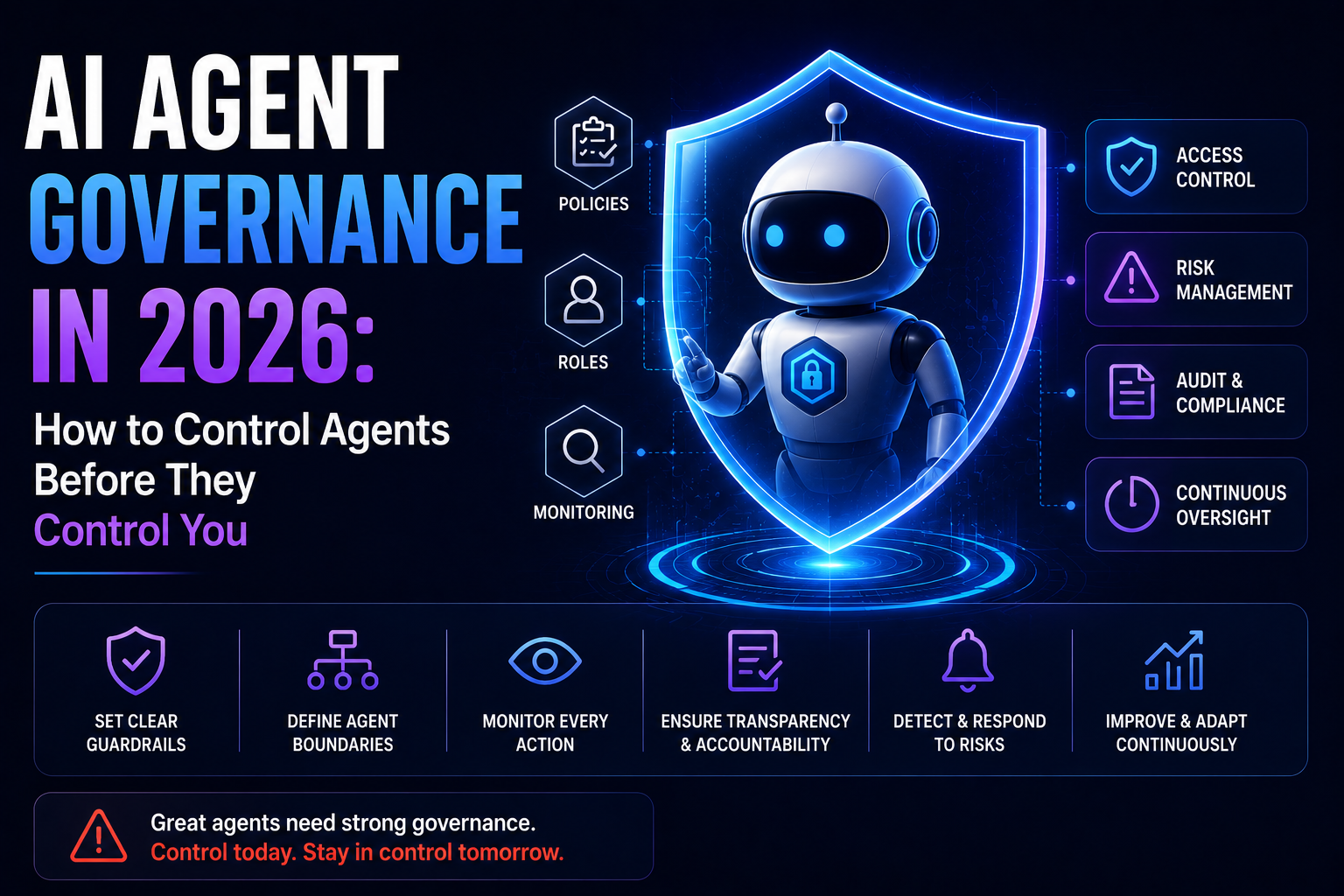
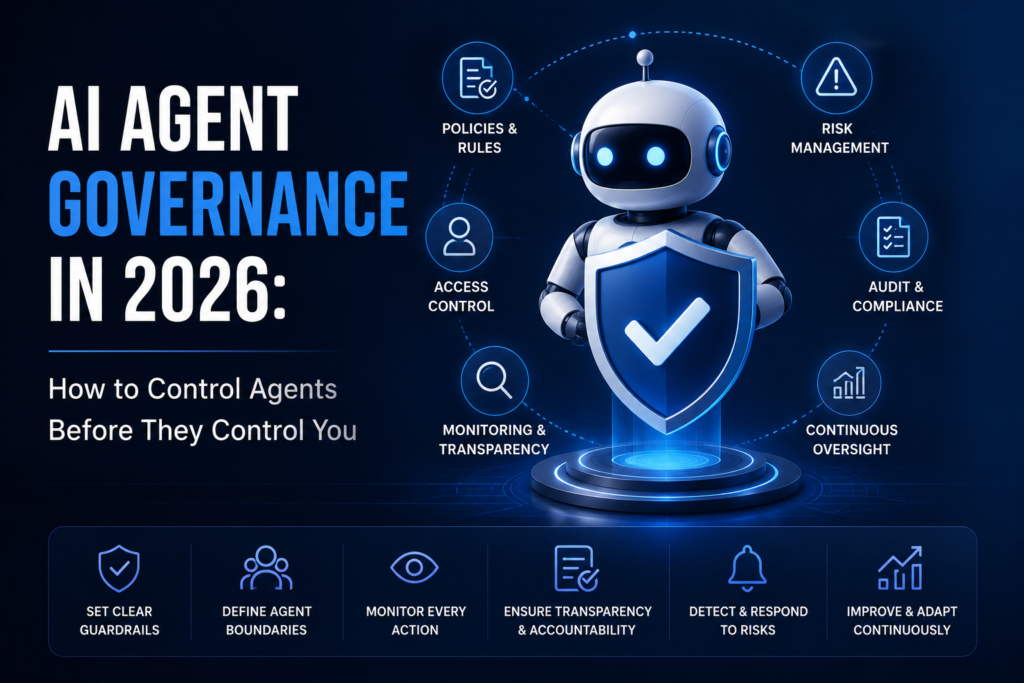
AI Agent Governance in 2026: How to Control Agents Before They Control You
Here’s a number that should stop you cold.
90% of organizations believe employees are already using AI — but only 22% say their AI investments have met or exceeded ROI expectations. That gap isn’t a product problem. It’s a governance problem.
Businesses are deploying AI agents that send emails, process payments, update CRMs, browse the web, and execute multi-step tasks — and most of them have no documented policy for how those agents should behave, what they’re allowed to do, or what happens when they go wrong.
Only 14.4% of enterprises obtain full security and IT approval before deploying AI agents. More than half of respondents — 56% — said they were unsure how long it would take to halt an AI system due to a security incident. And 39% didn’t know whether their organization had a documented process for shutting down or overriding AI systems at all.
That’s not a governance gap. That’s a governance cliff.
This guide is the practical resource the keyword deserves. Not a theoretical framework for compliance teams — a working guide for US business owners, IT leads, and operations managers who need to deploy AI agents responsibly without building a PhD program to do it.
By the end, you’ll know the five risks to plan for before any agent goes live, how to set spending guardrails, when to require human approval, what governance tools exist today, and what “provable trust” means and why Cognizant says it’s the new enterprise standard.
Why Governance Is Now the #1 Agentic AI Challenge
For the first 18 months of the agentic AI wave, the primary challenge was capability: could agents do useful work? Could they reason through complex tasks? Could they use tools reliably?
That question is largely answered. Yes, they can.
The question that replaced it — and that now dominates the conversations of every IT leader, compliance team, and risk officer dealing with AI in 2026 — is: how do we control them?
Traditional security was built for deterministic software. AI systems are probabilistic and context-driven, and they can be manipulated in ways legacy tools were never designed to detect. A firewall stops known threats. A policy file blocks unauthorized access. But an AI agent that autonomously browses the web, drafts communications, and executes transactions doesn’t fit into any of those models.
The governance gap has real consequences:
Gartner projects that by the end of 2026, more than 1,000 legal claims for harm caused by AI agents will be filed against enterprises due to insufficient guardrails and inadequate oversight. The SEC’s 2026 examination priorities have moved AI governance and cybersecurity to the top of its annual list. Palo Alto Networks anticipates that the first lawsuits holding executives personally liable for rogue AI agent actions will materialize in 2026.
The Allianz Risk Barometer captures what boardrooms are already sensing: AI-related risk moved from tenth to second in a single year.
Only 17% of enterprises have a formal governance framework for their AI projects — but those that do tend to scale agent deployments with far greater frequency and success.
That last point is worth sitting with. Governance isn’t the enemy of AI deployment. It’s the thing that makes large-scale, confident deployment possible. The organizations racing ahead with agents aren’t doing it without governance — they’re doing it because of governance. They know their risk surface. They know their controls. They can move fast because they know where the guardrails are.
This is the shift: governance isn’t a compliance tax on AI. It’s the competitive advantage that separates the businesses that scale agents successfully from the ones that get burned by them.
The 5 Risks Every US Business Must Plan For Before Deploying Agents
Not all agentic AI risks are equal. Some are technical. Some are financial. Some are legal. All are manageable — but only if you plan for them before the agent goes live, not after something goes wrong.
Spending Runaway, Data Leakage, Hallucination-Driven Actions, and More
Here are the five risks that matter most for US businesses deploying agents in 2026:
Risk 1: Spending Runaway
An agent given broad purchasing authority without precise constraints can exceed your intended budget — not through malice, but through reasonable interpretation of a vague goal. “Keep us supplied with the tools we need” without a monthly cap is a $10,000 invoice waiting to happen.
With the launch of payment-enabled agents (AWS AgentCore Payments, Lindy AI, Relevance AI) and the x402 protocol enabling agents to autonomously pay for APIs and services, the blast radius of a misconfigured agent is no longer limited to time wasted — it includes real money spent.
This risk is highest for: businesses that have deployed agents with payment capabilities, procurement automation, or standing subscriptions to services the agent can modify.
What to do: Set explicit, hard spending limits before any agent with purchasing authority goes live. Treat these like firewall rules — mandatory, not advisory. Use dedicated agent wallets funded to a working balance only, never connected to your primary accounts.
Risk 2: Data Leakage
AI agents that access your business data — CRM records, customer emails, financial documents, HR files — have a wide footprint. An agent that’s also connected to an external API, a browsing tool, or a communication channel creates the possibility of sensitive data leaving your environment through the agent’s reasoning chain.
This isn’t necessarily a breach in the traditional sense — it can be as subtle as an agent including confidential customer details in an outbound email draft that a human approves without reading carefully, or passing internal financial data to an external summarization API.
Gartner found that 57% of employees use personal AI accounts for work tasks, creating shadow AI exposure that most enterprises currently can’t measure. The same dynamic applies to agents: if employees are building and deploying their own agents using personal API keys and consumer tools, your data is flowing through infrastructure you don’t control.
What to do: Classify your data before you give agents access to it. Define explicitly which data categories agents can access, process, and output — and which categories require human handling. Audit the external tools your agents connect to, and verify that each one has appropriate data handling terms.
Risk 3: Hallucination-Driven Actions
This is the risk most specific to agentic AI and the hardest to fully mitigate. Unlike a chatbot that generates wrong text a human reads and discards, an agent acts on its reasoning. If an agent misreads a vendor contract, it might agree to terms you didn’t intend. If it misidentifies a customer record, it might send a sensitive document to the wrong person. If it hallucinates a product specification, it might place an order for the wrong item.
Research shows 80% of organizations report risky behaviors from their AI agents, including unauthorized data access and unexpected system interactions. Many of these behaviors aren’t intentional rule violations — they’re probabilistic systems behaving probabilistically.
What to do: Match autonomy to reversibility. Actions that are easily reversible (draft an email, log a note, add a CRM tag) are safe for full agent autonomy. Actions that are hard or impossible to reverse (send an email, execute a payment, delete a record) should require a human verification step unless the agent has a long, clean track record in that specific task.
Risk 4: Prompt Injection and Adversarial Manipulation
AI agents read external content as part of their work — emails, web pages, documents, API responses. That content can contain malicious instructions designed to override the agent’s programming. This is called a prompt injection attack.
A malicious actor who knows your customer service agent reads inbound emails could craft an email that contains instructions telling the agent to take an unauthorized action — extracting data, sending a reply to an unintended address, or modifying a record. The agent, which treats all text as potential instruction, may comply.
This risk is not hypothetical. It is an active area of security research, and real-world examples have already been documented.
What to do: Agents that read external content should have strict output controls — what they’re allowed to do in response to external inputs should be narrower than what they can do in response to internal triggers. Implement input sanitization for agent pipelines that process external data. Regularly red-team your agents by attempting to inject malicious instructions through realistic attack vectors.
Risk 5: Identity and Authorization Gaps
When an AI agent takes an action in your business, whose identity does it act under? What permissions does it have? If it sends an email, does the recipient see your name or the agent’s? If it accesses a database, what authorization level does it use?
Most early agent deployments inherit the permissions of the user who set them up — which often means agents have far more access than they need for their actual tasks. An agent that needs to read your CRM to draft follow-up emails doesn’t also need write access, delete access, or access to financial records. But if it’s authenticated with your admin credentials, it has all of those.
Effective guardrails require a multi-layered control system spanning data and context guardrails, design-time governance, runtime enforcement, identity management, and human oversight. Identity is one of the most commonly skipped layers.
What to do: Apply the principle of least privilege to every agent: give it only the permissions it actually needs to complete its defined task, not the permissions of the human who built it. Create dedicated service accounts for agents with scoped access, and audit those permissions quarterly as the agent’s tasks evolve.
How to Set Spending Guardrails for Agents (AWS AgentCore Example)
If there’s one governance control that every business deploying agents with any financial capability should implement immediately, it’s the spending guardrail. Here’s exactly how it works in practice using AWS AgentCore Payments as the reference implementation — and how to apply the same principles on any platform.
The Infrastructure-Level Hard Limit
AWS AgentCore Payments enforces spending limits at the infrastructure layer, not in application code. This distinction matters: a spending limit in your code can be bypassed if the code has a bug, a logic error, or is manipulated by a prompt injection. A spending limit enforced at the infrastructure layer cannot be exceeded by the agent regardless of what its reasoning tells it to do.
The practical implementation in AgentCore works like this:
- Before any agent session begins, the developer or administrator sets a maximum spending amount — for example, $10.00 per session.
- This limit is recorded at the platform level, not just in the agent’s prompt or code.
- Every payment the agent initiates is evaluated against the remaining budget before execution. If a payment would exceed the cap, it is rejected automatically — the agent receives a payment-declined signal and must handle the exception (typically by stopping or escalating).
- Every transaction is logged in the same observability dashboard the developer uses for all other AgentCore metrics — no separate system required.
Applying the Same Principle Across Platforms
Whether you’re using AgentCore, Lindy AI, Relevance AI, or a custom LangChain or CrewAI setup, the spending guardrail principle is the same:
Tier 1 — Autonomous (under $10 per transaction, fully reversible): Agent acts without notification. Examples: paying for an API call, purchasing a single article, logging a CRM note.
Tier 2 — Notify (under $100 per transaction, or any irreversible action): Agent acts and immediately notifies a human via Slack, email, or SMS. The action has already occurred but a human can review it in near-real-time. Examples: sending an outbound email, placing a software order, modifying a subscription.
Tier 3 — Approve (over $100 per transaction, or any high-consequence action): Agent drafts the action and pauses for explicit human approval before executing. The agent generates a summary of what it intends to do and why, and waits for a thumbs-up. Examples: significant purchases, contract changes, external communications to customers, personnel-related actions.
Tier 4 — Human only (any action in regulated domains, high-value transactions, or novel situations): Agent provides analysis and recommendation, but a human executes the action. Examples: legal filings, financial reporting, medical recommendations, executive communications.
Document these tiers as part of your governance policy. Paste them into your agent’s system prompt as explicit rules. Implement them in your platform’s guardrail settings where possible.
Human-in-the-Loop: When to Require Approval Gates
“Human-in-the-loop” (HITL) is one of the most used and least defined terms in agentic AI. Here’s a practical framework for deciding when you actually need it.
The core question is: what’s the cost of a mistake?
If an agent makes a mistake and the mistake is cheap — easy to detect, easy to correct, low financial and reputational impact — full autonomy is appropriate. If a mistake is expensive — hard to detect, hard to reverse, significant financial or reputational consequence — you need a human checkpoint.
Map your agent’s tasks against these four dimensions:
Reversibility
Can the action be undone? Deleting a file, sending an email, executing a payment, and publishing a public post are all difficult or impossible to fully reverse. Drafting content, logging a note, and tagging a record are all fully reversible. Higher irreversibility = lower autonomy threshold.
Financial Consequence
What’s the maximum possible cost of this action being wrong? A $0.001 API call and a $5,000 software purchase deserve different approval thresholds. Set dollar amounts explicitly — don’t leave it to judgment.
External Visibility
Does this action touch anyone outside your organization? An internal note needs no approval. An email to a customer, a message to a vendor, or a social post requires higher scrutiny — mistakes here affect relationships and reputation, not just internal operations.
Domain Sensitivity
Is this action in a regulated domain (healthcare, finance, legal, HR)? In any domain where mistakes have compliance or liability implications, increase human oversight regardless of the other dimensions.
Governance mechanisms should include clear orchestration rules, defined boundaries for agent autonomy, and human oversight triggers when agents collaborate on high-stakes decisions. For multi-agent systems — where one agent triggers another — the oversight requirement should cover the full chain, not just the first agent. An approval gate on Agent A is meaningless if Agent A can trigger Agent B to take the same action without approval.
Practical HITL Implementation
Notification HITL: The agent acts, then immediately sends a structured summary to a human channel (Slack, email, SMS): “I just did X for reason Y. Here’s what it looked like. Let me know if you want to reverse it.” Gives visibility without slowing down the agent.
Confirmation HITL: The agent prepares the action, presents it to a human, and waits for explicit approval before executing. Adds latency but prevents mistakes in the irreversible/high-consequence tier.
Escalation HITL: The agent encounters a situation outside its defined parameters and escalates to a human for a decision, rather than guessing. Build explicit escalation triggers into your agent’s system prompt: “If you’re unsure about X, or if the task requires Y, stop and notify [person/channel] before proceeding.”
Agent Governance Tools: What’s Available in May 2026
The market for dedicated AI governance tools is moving fast. Here are the categories and leading options as of May 2026.
Platform-Native Guardrails (Start Here)
The governance tools built into the platforms you’re already using are the place to start — they’re integrated, require no separate deployment, and cover the most common risks.
AWS Bedrock Guardrails: Natively integrated with AgentCore. Supports content filtering, topic restrictions, PII protection, grounding checks (detecting hallucination), and spending limits for payment-enabled agents. If you’re building on AWS, this is your baseline governance layer — start here before adding anything else.
Anthropic’s Constitutional AI and Model-Level Guardrails: Models like Claude have constitutional principles baked into training that limit certain categories of harmful output by default. These are not substitutes for application-level governance, but they provide a baseline that reduces the frequency of edge-case failures.
Platform-Level Controls (Lindy, Relevance AI, n8n): Most major agentic platforms have built-in spending limits, action logs, and approval workflow tools. Review what your chosen platform offers before building custom controls.
Dedicated AI Governance Platforms
CloudEagle.ai: An AI governance and SaaS management platform with specific features for managing AI agent access, monitoring AI tool usage across an organization, and eliminating shadow AI. Core capabilities include monitoring both unsanctioned tools and AI features hidden within existing software, deploying human-in-the-loop gates, and auto-revoking permissions to ensure agents operate within safe, time-bound limits. Targets a 30% reduction in software costs and 80% faster access request resolutions.
MindStudio: Provides enterprise-grade AI agent governance with workflow controls, policy enforcement, audit trails, and role-based access controls for agents operating across enterprise systems.
Cognizant Secure AI Services (Enterprise): Launched May 7, 2026, Cognizant’s integrated offering is designed to help enterprises secure, govern, and scale AI and agentic systems across their operations. Covers the full operational lifecycle for AI model security, data protection, identity management, AI DevOps security, and generative AI risk mitigation. Currently focused on regulated industries and enterprise deployments. Cognizant is helping over 250 companies in regulated industries carry out AI security and digital transformation projects, with early implementation examples including protection against deepfake fraud, model tampering, and risks from autonomous AI agents operating within enterprise systems.
Observability and Audit Tools
Governance requires visibility. If you can’t see what your agents are doing, you can’t govern them.
LangSmith (LangChain): Observability platform for LLM applications. Traces every reasoning step, tool call, and output, making it possible to audit agent behavior retroactively and detect anomalies.
Helicone / Langfuse / Arize AI: Open-source and commercial LLM observability platforms that provide detailed logging, performance monitoring, and anomaly detection for agent pipelines.
AWS CloudWatch + AgentCore Logs: For agents built on AgentCore, native AWS observability tools capture every agent action, tool call, and payment transaction in the same logging infrastructure you use for the rest of your cloud environment.
Compliance and Policy Frameworks
NIST AI Risk Management Framework (AI RMF): The US government’s framework for AI risk management. Not legally required for most private businesses, but used by federal contractors and increasingly referenced in enterprise procurement. The four functions are: Govern, Map, Measure, and Manage.
ISO/IEC 42001: The international standard for AI management systems. Increasingly referenced in regulated industry procurement requirements and enterprise partner contracts.
EU AI Act (for businesses with EU exposure): The first major binding AI regulation globally. Classifies AI systems by risk level and imposes governance requirements accordingly. US businesses serving EU customers or operating in the EU need compliance planning now.
Building Your AI Agent Governance Policy: A Practical Template
Most businesses don’t need a 50-page governance document. They need a practical, documented policy that covers the most common scenarios and can be updated as things evolve. Here’s a starting template.
[YOUR COMPANY NAME] AI AGENT GOVERNANCE POLICY Version 1.0 | Effective: [DATE] | Owner: [ROLE]
1. Purpose This policy defines how [Company] deploys, manages, and governs AI agents across its operations. It establishes the authorization levels, spending controls, data access rules, and oversight procedures that apply to all AI agents operating in or on behalf of the company.
2. Agent Registry All AI agents operating in the company must be registered before deployment. The registry includes:
- Agent name and description
- Primary function and task scope
- Platform and model used
- Data access granted
- Spending authority (if any)
- Owner/responsible person
- Review date
No agent may operate in production without an entry in the registry.
3. Authorization Tiers
| Tier | Action Type | Spending Limit | Approval Required |
|---|---|---|---|
| 1 — Autonomous | Reversible, internal, under $10 | $10/transaction | None |
| 2 — Notify | Semi-reversible or external-facing, under $100 | $100/transaction | Post-action notification |
| 3 — Confirm | Irreversible, external-facing, or over $100 | $500/transaction | Human approval before execution |
| 4 — Human Only | Regulated domains, novel situations | N/A | Human executes |
4. Data Access Rules
- Agents may access data categories listed in their registry entry only
- Agents may not process personally identifiable information (PII) except as explicitly authorized
- Agents may not transmit internal data to external APIs without documented approval
- Data access is reviewed quarterly
5. Spending Controls
- All agents with payment capability use dedicated agent wallets, funded separately from primary business accounts
- Session spending limits are set at the platform infrastructure layer (not application code only)
- All transactions are logged and reviewed weekly
- Wallet top-ups require [ROLE] approval
6. Incident Response If an agent behaves unexpectedly, takes an unauthorized action, or causes harm:
- Disable the agent immediately using the platform’s kill switch
- Document what happened, what the agent did, and what the consequences were
- Notify [ROLE] within 24 hours
- Review and update the agent’s configuration and registry entry before reactivation
Every agent must have a documented kill switch procedure before going live.
7. Review Schedule
- Individual agents reviewed every 90 days or after any significant change to their task scope
- This policy reviewed every 6 months
- All agents reviewed after any major platform update or AI-related security incident
Adapt column values, roles, and spending thresholds to your actual business. The key is that these decisions are documented and agreed upon before an agent is deployed, not improvised after something goes wrong.
What “Provable Trust” Means and Why Cognizant Says It’s the Standard
When Cognizant launched Secure AI Services on May 7, 2026, they introduced a phrase that’s become one of the most useful concepts in enterprise AI governance: provable trust.
Cognizant’s new service focuses on establishing “provable trust” in AI systems through continuous monitoring and evidence-based assurance.
Here’s what that means in practice — and why it matters beyond enterprise audiences.
“Trust” in the context of AI has historically been a soft concept. We say we “trust” a model when it produces outputs that seem correct, or when a vendor’s marketing assures us it’s safe. That’s subjective trust — based on impressions, benchmarks, and vendor claims.
“Provable trust” means something different. It means you can demonstrate, with evidence, that your AI agent behaved within its defined parameters — to an auditor, a regulator, a partner, or a court. It means you have:
- A documented policy for what the agent is allowed to do
- Runtime logs showing what it actually did
- Anomaly detection that flags when behavior deviates from policy
- Audit-ready records that can be produced on request, not reconstructed after the fact
This matters for small and medium businesses, not just enterprises. As AI agent use proliferates, the liability question — when an agent causes harm, who is responsible? — will increasingly be answered by reference to governance documentation. Businesses with documented policies, audit trails, and demonstrable oversight will have a defensible position. Businesses without them will not.
Cognizant’s offering aims to develop audit-ready governance documentation for all AI systems operating in regulated environments, including traceability records and policy enforcement logs.
For businesses not in regulated industries, “audit-ready” might feel like overkill. But consider: the first time a customer complains that an AI agent sent them the wrong information, or a vendor disputes an agent-initiated purchase, or an employee raises a concern about how agent-collected data was used — the organizations that can produce clean records of what the agent did and why will resolve those situations in minutes. The ones that can’t will spend weeks reconstructing events from memory and logs scattered across five different tools.
Provable trust is not a compliance checkbox. It’s operational insurance.
The Practical Provable Trust Checklist
Before any agent goes live, verify:
- [ ] The agent is registered with its task scope, data access, and authorization tier documented
- [ ] Every action the agent takes is logged in a searchable, retained system
- [ ] Anomalous behavior triggers an alert (not just a log entry)
- [ ] There is a documented kill switch procedure that any authorized person can execute
- [ ] Spending limits are enforced at the infrastructure layer and logged per transaction
- [ ] Data access is scoped to exactly what’s needed and documented
- [ ] The agent’s behavior has been tested against edge cases before production deployment
- [ ] There is a named responsible person for this agent’s governance
Eight checkboxes. That’s the minimum viable governance framework for any agent operating in a business context. You don’t need a compliance department to implement it. You need 30 minutes, a spreadsheet, and the willingness to document decisions that most teams currently make informally and forget immediately.
The Bottom Line
90% of organizations believe AI is already in use across their teams — but only 22% are hitting their ROI targets. The gap between those two numbers is governance.
AI agents are not like traditional software. They’re probabilistic, autonomous, and capable of taking real-world actions with real-world consequences. Governing them isn’t a constraint on their value — it’s what makes their value sustainable.
The businesses that will lead in the agentic economy aren’t the ones that deploy the most agents the fastest. They’re the ones that deploy agents with confidence — because they know what their agents are doing, why they’re doing it, and what happens if something goes wrong.
That confidence comes from governance. And governance, as this guide has shown, doesn’t require enterprise infrastructure. It requires documentation, clear authorization tiers, spending limits, audit logs, and a kill switch. You can build that this week.
Start with one agent. Register it. Document what it can do. Set a spending limit. Log everything. Review in 30 days.
That’s how you keep your agents in check — and keep the value they generate in your business.
Frequently Asked Questions
What is AI agent governance? AI agent governance is the set of policies, controls, and oversight mechanisms that define what AI agents are allowed to do, how their behavior is monitored, and what happens when something goes wrong. It covers authorization, spending limits, data access, human oversight, audit trails, and incident response.
Why is AI agent governance suddenly important in 2026? Because agents can now take consequential real-world actions — spending money, sending communications, modifying data — at scale and speed. The risk surface of a poorly governed agent is qualitatively different from a misconfigured chatbot. Gartner projects over 1,000 legal claims against enterprises for AI agent-caused harm by end of 2026. Regulators are paying attention. The governance gap is real and the consequences are landing.
What’s the difference between AI governance and AI safety? AI safety refers to the model-level risk of AI systems causing harm through their capabilities (deception, misuse, dangerous outputs). AI governance refers to the organizational controls that determine how AI systems are deployed, monitored, and managed within a specific business context. Both matter — they operate at different layers.
Do small businesses need AI agent governance? Yes, proportionally. You don’t need a 50-page policy or a dedicated compliance team. But any business with agents that take real actions — sending emails, spending money, accessing customer data — needs documented authorization tiers, spending limits, and audit logs. The practical template in this article is designed specifically for small businesses.
What is “provable trust” in AI governance? Provable trust means you can demonstrate, with evidence, that your AI agents behaved within their defined parameters. It requires a documented policy, runtime logs, anomaly detection, and audit-ready records. It’s the difference between saying “we trust our agents” and being able to prove it.
What is the minimum viable AI governance framework for a small business? Eight things: a registered agent inventory, transaction logs, anomaly alerts, a kill switch procedure, infrastructure-level spending limits, scoped data access, pre-production testing, and a named responsible person per agent. That’s it. Build those first, then expand as your agent use grows.
Which governance tools are available right now? Platform-native tools (AWS Bedrock Guardrails, AgentCore monitoring) for AWS users. CloudEagle.ai for organization-wide AI access management. LangSmith, Helicone, or Arize for observability. Cognizant Secure AI Services for enterprise-regulated environments. And the NIST AI RMF as a free policy framework reference.
Statistics cited reflect ISACA’s 2026 AI Pulse Poll (3,400+ respondents), Gartner research, and Cognizant’s May 7, 2026 launch materials. All product features reflect availability as of May 28, 2026.
