
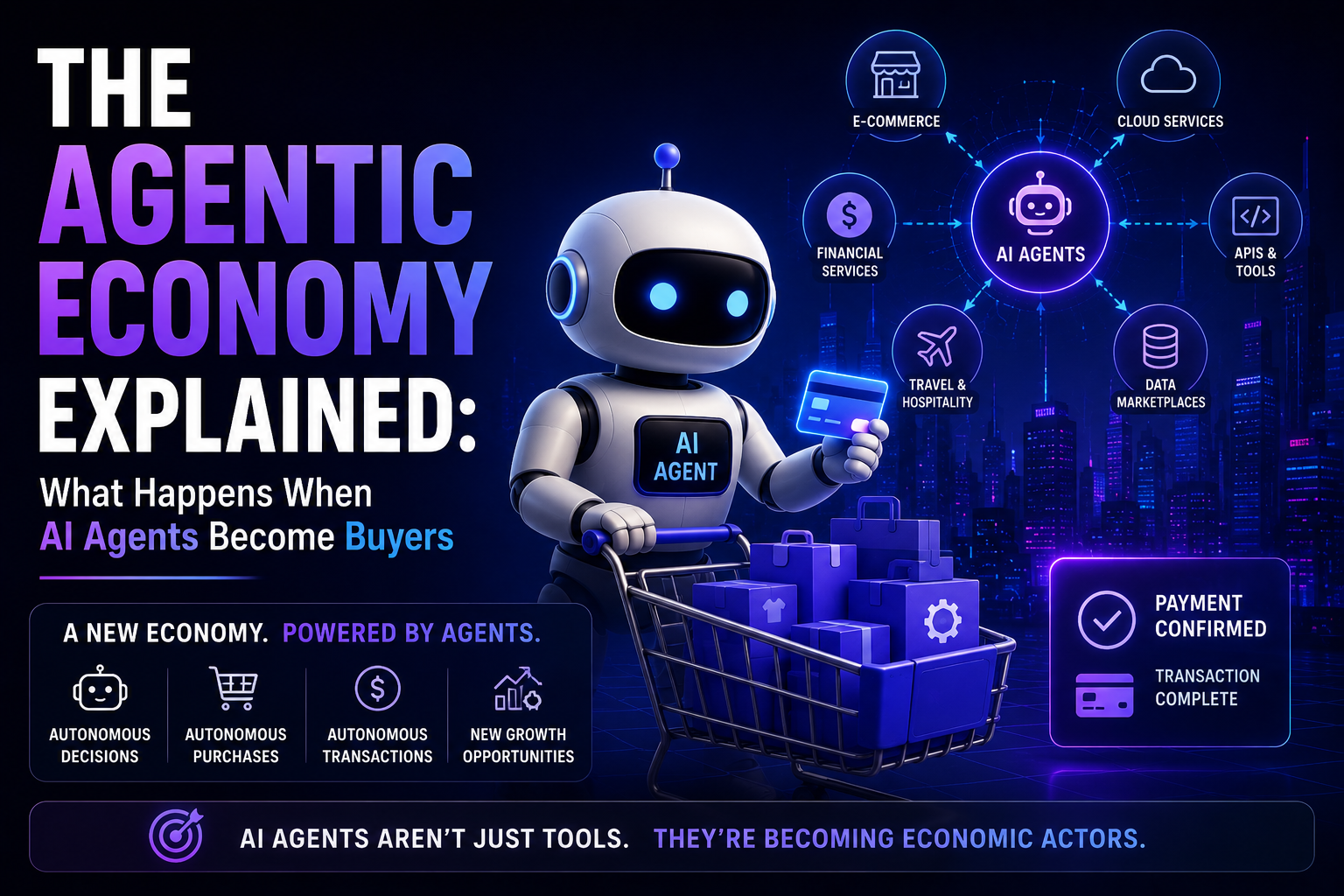
The Agentic Economy Explained: What Happens When AI Agents Become Buyers
For the entire history of commerce, there has been one constant: a human being on the buying end.
Humans browse. Humans compare. Humans decide. Humans check out. Every piece of commerce infrastructure ever built — credit cards, checkout flows, subscription billing, return policies — was designed for people with browsers and wallets and fingers to tap buttons.
That assumption is now breaking.
In 2026, AI agents are beginning to replace humans at every stage of the buying process. They research products. They compare vendors. They negotiate terms. They complete purchases. And in a growing number of cases — powered by new protocols like x402 and infrastructure like AWS AgentCore Payments — they spend money on their own, without asking anyone first.
This is the agentic economy: a world where AI agents are not just tools that assist buyers, but autonomous economic actors who are the buyers.
This guide explains what that means, what’s actually happening right now, what it means for US small businesses, and what the risks are before you get swept up in the hype.
What Is the Agentic Economy (and Why Did It Just Arrive)?
The agentic economy is a term used to describe the emerging economic system in which AI agents act as independent buyers, sellers, and service brokers — transacting with merchants, APIs, data providers, and each other on behalf of their human principals, often without real-time human approval.
It’s easiest to understand in contrast to what came before it:
- In the search economy, humans searched for products and made purchase decisions themselves. Commerce was optimized for human eyes and human psychology.
- In the recommendation economy, platforms like Amazon and Netflix used algorithms to guide human choices — but humans still clicked “Buy.”
- In the agentic economy, an AI agent receives a goal (“research the best software for invoicing under $50/month and set it up”), conducts the research, selects the product, pays for it, and completes the setup — without a single human clicking anything.
This isn’t science fiction. It’s already happening across multiple dimensions simultaneously.
By 2028, analysts project that 90% of B2B buying will be AI agent-intermediated, driving over $15 trillion of B2B spend through AI agent exchanges. Consumer-facing autonomous agents are expected to handle $150 billion in transactions by the end of 2026. The broader agentic AI market is projected to grow from $5.2 billion in 2024 to $196.6 billion by 2034 — a 43.8% compound annual growth rate that outpaces nearly every other technology sector.
Why did it arrive in 2026 specifically? Three forces converged at once:
1. LLM capability crossed a threshold. Today’s large language models don’t just answer questions — they reason through multi-step problems, use tools, handle exceptions, and maintain context across long task sequences. That’s the cognitive foundation that makes autonomous purchasing possible.
2. Payment rails caught up. Until May 2026, there was no standard, frictionless way for an AI agent to pay for something mid-task. The launch of x402, AgentCore Payments, and Stripe’s Machine Payments Protocol provided the financial infrastructure agents needed.
3. Standards emerged. Google’s Universal Commerce Protocol (UCP), the x402 Foundation, Stripe’s Agent Commerce Protocol (ACP), and the Linux Foundation’s Agentic AI Foundation all launched in 2025–2026. Standards reduce integration cost, which accelerates adoption.
Three forces are accelerating agentic commerce specifically in 2026: consumer readiness driven by habitual trust in recommendation algorithms, maturing LLM capabilities that understand preferences and constraints, and new industry standards that allow retailers, platforms, and agents to interoperate.
The agentic economy didn’t arrive all at once. But the infrastructure it required just finished being built.
From Human Checkout to Agent Checkout: The Shift in 3 Steps
To understand what the agentic economy means practically, here’s how the shift from human-driven to agent-driven commerce actually plays out — not as a sudden replacement, but as a gradual escalation of autonomy across three stages.
Stage 1 — AI-Assisted Discovery (Already Mainstream) A human tells their AI assistant: “Find me the best project management tool for a 5-person team under $30/month.” The AI searches, compares, and presents options. The human still makes the final choice and completes the purchase manually.
This stage is already widespread. In 2026, 73% of consumers report using AI agents or AI-powered assistants at some point in their purchase journey, according to Salesforce’s latest State of Commerce report. AI influences what gets considered — but humans still decide.
Stage 2 — AI-Mediated Decision + Human Checkout (Rapidly Growing) The AI agent goes further: it researches, ranks options, recommends a specific product, and prepopulates checkout — but hands off to a human to confirm and complete payment. The human’s role shrinks to final approval.
About 65% of US consumers trust AI to compare prices, but only 14% trust it to place orders on their behalf — meaning the large majority of today’s consumer AI commerce sits at Stage 2, not Stage 3.
Stage 3 — Fully Autonomous Agent Commerce (Growing Fast in B2B) The agent executes the entire process: research, vendor selection, payment, and confirmation — without human intervention. A human set the goal and the budget constraints. The agent handles everything else.
This stage is already the norm in API micropayments (powered by x402), is accelerating in B2B procurement, and is beginning to appear in consumer commerce through platforms like Amazon Rufus and OpenAI’s shopping agents.
McKinsey describes a Level 4 of agentic commerce where agents operate against standing goals rather than one-off transactions — maintaining household essentials under a monthly budget, maintaining airline loyalty status at the lowest cost, ensuring baby supplies never run out — continuously monitoring needs, anticipating replenishment, and comparing options across merchants without human involvement at all.
The AWS + Coinbase + Stripe Announcement That Changed Things
The single clearest signal that the agentic economy has moved from concept to infrastructure came on May 7, 2026.
AWS launched Amazon Bedrock AgentCore Payments — built with Coinbase and Stripe — enabling AI agents deployed on AWS to autonomously discover, pay for, and access APIs, data feeds, web content, and other agents during the execution of a task. No human approval required per transaction. Spending limits enforced at the infrastructure layer.
The payment rail underneath it is x402 — an open protocol that activates the long-dormant HTTP 402 “Payment Required” status code to enable sub-cent, real-time stablecoin micropayments between machines. The x402 Foundation that governs it has 22 founding members including AWS, Google, Microsoft, Visa, Mastercard, Stripe, Shopify, and Cloudflare.
This is not one company experimenting. This is the entire digital commerce infrastructure industry agreeing that AI agents need payment rails — and building them simultaneously.
Brian Foster of Coinbase captured the scale of the bet: “There will soon be more AI agents transacting than humans, and they need money that’s built for the internet — programmable, always on, and global.”
What AI Agents Are Buying Right Now (and What They’ll Buy Next)
The agentic economy is not uniform. Agents are buying different things at different stages of development, with very different transaction values and risk profiles.
What Agents Are Buying Right Now
API access and data feeds. This is the most mature category. AI agents are already paying for real-time data — financial markets, social data, web content, AI inference, weather data — in fractions of a cent per call, powered by x402. By late April 2026, x402 alone had processed 165 million transactions totaling roughly $50 million, with an average transaction value near $0.30. This is machine-to-machine commerce at volume.
Research and paywalled content. Agents tasked with competitive intelligence, financial analysis, or market research are beginning to pay for individual articles, reports, and datasets on a per-access basis — rather than requiring a developer to pre-register subscriptions.
Software subscriptions via B2B procurement agents. Gartner predicts that by the end of 2026, 25% of enterprise software purchases will involve some form of AI agent mediation. Procurement agents are handling vendor evaluation, contract comparison, and purchase authorization within pre-defined spending policies.
AI inference and compute. Agents are purchasing GPU compute and model inference from third-party providers on demand — paying only for the processing power they need for a specific task.
Comparison shopping and basket building. 53 million shopping queries now flow through AI platforms daily. Agents are increasingly doing the research phase of product discovery autonomously, with basket-building capabilities emerging for both B2C and B2B use cases.
What Agents Will Buy Next
AWS has publicly stated that micropayments are the first phase, with future capabilities explicitly targeting:
Travel and hospitality. Agent-initiated hotel and flight bookings — the agent receives a goal (“book a flight to Chicago next Tuesday under $400”), handles the search, comparison, and payment, and delivers a confirmation. Warner Bros. Discovery has publicly stated it’s exploring AgentCore Payments for agent-initiated content purchases triggered by contextual cues.
Merchant payments. Full agent-to-merchant checkout for physical and digital goods — the consumer sets a goal, the agent handles everything. Morgan Stanley predicts that nearly half of online shoppers will use AI shopping agents by 2030, accounting for approximately 25% of their spending.
Agent-to-agent transactions. Specialized AI agents will buy services from other AI agents — a research agent paying a data agent, a writing agent paying a fact-checking agent — creating a machine-to-machine economy layered beneath the human-facing one.
Standing-goal commerce. The highest level of agentic commerce involves agents operating against ongoing goals rather than one-off tasks — automatically managing replenishment, renewals, substitutions, and exceptions, with humans stepping in only for meaningful decisions or exceptions.
How the Agentic Economy Affects US Small Businesses
For US small business owners, the agentic economy cuts both ways: it’s a source of new productivity and a source of new competitive risk. Understanding both sides is essential.
As a Buyer: The Productivity Opportunity
Small businesses are already using AI to automate research, communication, and scheduling. The agentic economy extends that into procurement and operations. Here’s what that means in practice:
Automated vendor research and switching. An operations agent can continuously compare your current software subscriptions against alternatives, flag better options when they emerge, and — with appropriate permissions — execute the switch. The average US small business wastes significant spend on suboptimal software simply because nobody has time to re-evaluate.
B2B procurement at scale. 84% of B2B buyers using AI tools are speeding up their research and decision-making processes. For a 5-person business that previously spent hours on vendor evaluation, an agent that completes the same research in minutes is a genuine multiplier.
Automated data and research acquisition. Agents that can pay for exactly the data they need — market data, competitor monitoring, lead research — without pre-negotiated subscriptions give small businesses access to premium intelligence that was previously only economical for enterprises.
Close to 60% of US small businesses are already using AI, up 18% year-over-year in 2025 and double the amount since 2023, according to a US Chamber of Commerce report. The agentic economy is the next acceleration of that trend.
As a Seller: The Discoverability Risk
Here’s the uncomfortable flip side: if AI agents are becoming the primary buyers, then businesses that aren’t visible to agents are increasingly invisible to buyers.
AI agents are less forgiving than humans. Where a shopper might tolerate missing details or inconsistent descriptions, an agent is more likely to skip products with incomplete attributes, ignore inconsistent listings, or deprioritize those with outdated inventory or pricing.
Products with structured data are cited 3.1x more frequently in Google AI Overviews than those without. If your product catalog, pricing, and availability aren’t structured in a machine-readable format, agents may simply not consider you — no matter how good your product actually is.
For small businesses, this creates three urgent priorities:
- Structured product and service data. Your website needs schema.org markup, consistent attributes, and real-time pricing that agents can parse. This is the new SEO.
- API-accessible inventory and pricing. Businesses that expose their catalog via API become selectable by agents. Those that don’t are invisible to the fastest-growing buyer segment.
- Agent-readable trust signals. Reviews, certifications, return policies, and shipping terms need to be in formats that machines can read and incorporate into their decision logic.
Risks: What Happens When Agents Spend Wrong?
The agentic economy comes with real risks, and an honest guide has to address them plainly.
When a chatbot hallucinates, you get a wrong answer. When an agent hallucinates, it might result in unauthorized transactions, data loss, and incorrect decisions, which could lead to compliance and security issues.
Here are the four most significant risk categories, and what to do about each:
1. Misconfigured Spending and Budget Overruns
An agent given broad purchasing authority without precise constraints can exceed your intended budget — not through malice, but through misinterpretation of goal parameters. An instruction like “keep us supplied with office materials” without a monthly cap could result in a very large order.
What to do: Always set explicit, hard spending limits before deploying any agent with purchasing authority. The best agentic platforms (AgentCore, Lindy, Relevance AI) enforce these at the infrastructure layer — meaning the agent literally cannot exceed the cap regardless of what its logic instructs. Treat spending limits like firewall rules: mandatory, not advisory.
2. Hallucination-Driven Bad Purchases
A misconfigured agent could buy the wrong product, exceed your operating budget, or get tricked by a manipulated product listing. Agents reason probabilistically, which means they can occasionally misread vendor terms, product specifications, or pricing structures — and act on the misread.
What to do: For high-value purchases, require human-in-the-loop approval before the agent completes the transaction. Use agents fully autonomously only for low-value, reversible purchases where an occasional error is acceptable. Build in post-purchase verification steps that check the order against the original goal.
3. Security and Fraud Exposure
Agent-to-agent transactions create new attack surfaces for malicious actors. Standardized protocols must include robust authentication, encryption, and fraud detection mechanisms. A compromised agent with payment credentials is a very different threat than a compromised email account.
Specific risks include prompt injection attacks (malicious instructions embedded in content the agent reads), agent impersonation (fraudulent agents pretending to be legitimate services), and credential exposure if wallet keys are not properly secured.
What to do: Never give agents access to your primary payment credentials. Use dedicated agent wallets with limited balances — funded separately from your main accounts. Treat agent wallets like petty cash: funded to a working limit, refilled as needed, never overloaded. Review transaction logs regularly, exactly as you would a corporate card statement.
4. Accountability and Liability Gaps
When an agent negotiates unfavorable terms or makes purchasing errors, liability becomes complex. Current consumer protection frameworks were designed for human buyers. There is no specific regulatory framework for agentic commerce today.
Working with your compliance team before deploying agent-driven purchasing will save headaches later. There’s no specific regulatory framework for agentic commerce today, but regulators are paying attention to AI-driven financial transactions and new rules are likely on the horizon. Prepare by documenting your agent governance policies, maintaining clear audit trails, and building flexibility into your systems.
What to do: Document every agent’s purchasing authority in writing — what it can buy, the maximum it can spend per transaction, per day, and per month, and what requires escalation to a human. This documentation protects you when something goes wrong, and positions you well when regulations eventually arrive.
The Future: Travel, E-Commerce, and Merchant Payments via Agent
The clearest picture of where the agentic economy goes next comes from two sources: what AWS explicitly said is on its roadmap, and what McKinsey describes as the highest levels of agentic commerce maturity.
Travel and Hospitality
Agent-initiated travel booking is one of the most clearly articulated near-term use cases. AWS has named hotel reservations and flight bookings as explicit roadmap targets for AgentCore Payments. The workflow is straightforward: a human sets a goal and constraints (“book me a hotel near the convention center for May 22–24, under $200/night, cancellable”), and the agent handles the search, comparison, payment, and confirmation.
For travel businesses and hotels, this shifts the discovery moment. When an AI agent is evaluating hotels, it’s not looking at hero photography or emotional copywriting. It’s parsing structured data: availability APIs, rate APIs, cancellation policy data, and review aggregations. Businesses without real-time API access to their inventory will be skipped.
E-Commerce and Consumer Retail
By 2025’s end and accelerating into 2026, traffic to retail sites from generative AI increased 4,700% year-over-year. The shift has already begun. AI agents are driving enormous discovery traffic to retailers — but conversion rates for in-agent purchasing lag significantly behind traditional channels, largely because the checkout infrastructure isn’t agent-ready yet.
The Agentic Commerce Protocol (ACP) launched in 2025 as a minimum viable standard for single-item purchases and basic checkout flows, with 2026 bringing multi-item cart support as a major maturity milestone. When a user tells an agent to “order everything I need for taco night,” the agent needs to build and purchase a multi-item cart — a capability the protocols are actively developing.
B2B Procurement
This is where agentic commerce is already most advanced, because B2B workflows are ideally suited to agent automation. B2B workflows spanning multi-step approvals, negotiations, quote generation, recurring orders, compliance checks, and inventory management are inherently complex and often rely on manual work — making processes error-prone and slow. Agents that handle these workflows don’t just save time; they reduce errors and enable a level of vendor comparison that was previously economically impossible.
1 in 5 sellers will soon be compelled to respond to AI-powered buyer agents with dynamically delivered counteroffers via seller-controlled agents — creating an economy where AI agents negotiate with other AI agents, with humans setting the parameters and reviewing the outcomes.
How to Prepare Your Business for Agent-First Commerce
Whether you’re primarily a buyer, a seller, or both, the agentic economy requires concrete preparation. Here’s what to prioritize in 2026.
If You’re Primarily a Buyer (Using Agents to Procure)
Start with a spend inventory. List every recurring software subscription, data service, and vendor relationship you have. These are the places where a well-configured purchasing agent would look first for optimization.
Set tiered authorization levels. Decide in advance: what can an agent buy autonomously (under $10, reversible), what requires notification (under $100), and what requires approval (anything larger or irreversible). These tiers should be configured into your agent platform before any purchasing authority is granted.
Use dedicated agent wallets. Fund agent wallets with a working balance only — never give agents direct access to your primary bank or card accounts. Treat each agent’s wallet like a prepaid debit card with a weekly refill limit.
Audit transaction logs weekly. Until you have confidence in how your agents behave, review their spending the same way you’d review an employee expense report.
If You’re Primarily a Seller (Optimizing to Be Bought by Agents)
Audit your machine readability. How would an AI agent see your business? Search for your products in ChatGPT, Perplexity, and Google AI Mode. What does it find? What does it miss? What data is incomplete or stale?
Implement schema.org markup. Pages with structured data are cited 3.1x more frequently in AI Overviews than those without. Schema.org Product markup is not optional for businesses that want to be selectable by agents — it’s the foundation.
Expose an API. Even a simple read-only API for your product catalog, availability, and pricing dramatically increases your accessibility to agent-driven buyers. This doesn’t require a developer team — platforms like Shopify and WooCommerce provide these APIs out of the box; you just need to verify they’re active and accurate.
Think about agent trust signals. Agents evaluate vendors on criteria humans don’t always prioritize: response time, API reliability, data freshness, return policy clarity. Build these into how you present your business to machine buyers.
Consider x402 compatibility. If you sell digital services, data, or API access, becoming x402-compatible lets AI agents discover and pay for your service at runtime — without requiring a pre-negotiated relationship. The x402 Bazaar alone has over 10,000 endpoints today. Being listed there is free exposure to 69,000 active AI agents.
The Mindset Shift
The fundamental change the agentic economy requires is recognizing that you now have two audiences for everything your business does: humans and machines. Your website, your product catalog, your pricing page, your onboarding flow — all of it now needs to be readable and actionable by both.
If your catalog, policies, and value proposition are not machine-readable, agents — and by extension, shoppers — simply will not find you, no matter how beloved your brand is.
The businesses that win in the agentic economy won’t necessarily be the biggest or best-known. They’ll be the most data-complete, most API-accessible, and most transparent about their capabilities and pricing — because those are the attributes machines optimize for when the buying decision is theirs to make.
The shift won’t happen all at once. It will happen gradually, then suddenly. The gradual part is already underway. The sudden part is what 2026 is beginning to look like.
Frequently Asked Questions
What exactly is the agentic economy? The agentic economy is the emerging economic system where AI agents act as autonomous buyers, completing research, vendor selection, and payment on behalf of their human users — often without requiring real-time human approval for individual transactions.
Is the agentic economy real right now, or is it still theoretical? It’s real, but unevenly developed. AI agents already transact at scale in B2B software procurement, API micropayments (via x402, which has processed 165 million transactions), and AI-assisted consumer discovery. Fully autonomous consumer checkout is emerging but not yet mainstream — most consumer commerce today is at Stage 2 (AI-assisted decision, human checkout).
Does the agentic economy affect my small business even if I don’t use AI agents? Yes — primarily on the seller side. If AI agents are mediating an increasing share of buying decisions, and your business isn’t machine-readable, you’re increasingly invisible to that buying channel. This affects discoverability regardless of whether you’re personally deploying agents.
What’s the difference between agentic commerce and regular e-commerce? Traditional e-commerce assumes a human buyer browsing, comparing, and checking out. Agentic commerce assumes the buyer is an AI agent interpreting a human’s goal and executing autonomously. The infrastructure, optimization strategies, and competitive dynamics are meaningfully different.
What’s the biggest risk of the agentic economy for a small business? For buyers: unconfigured spending authority leading to budget overruns or bad purchases. For sellers: data invisibility — not having machine-readable product and pricing data means agents don’t consider you.
How much is at stake? The agentic AI market is forecast to exceed $30 billion by 2028, and global agentic commerce could reach $3 to $5 trillion by 2030. The businesses that build the right infrastructure now will capture disproportionate value as those numbers materialize.
What’s the first step I should take? Search for your business, products, or services in ChatGPT and Perplexity. Read what they say. What’s accurate? What’s missing? What’s outdated? That gap is your starting point.
Statistics cited reflect figures from Salesforce, McKinsey, Gartner, Coinbase, AWS, Morgan Stanley, and the US Chamber of Commerce as reported through May 2026. All projections are forward-looking estimates subject to change.
