
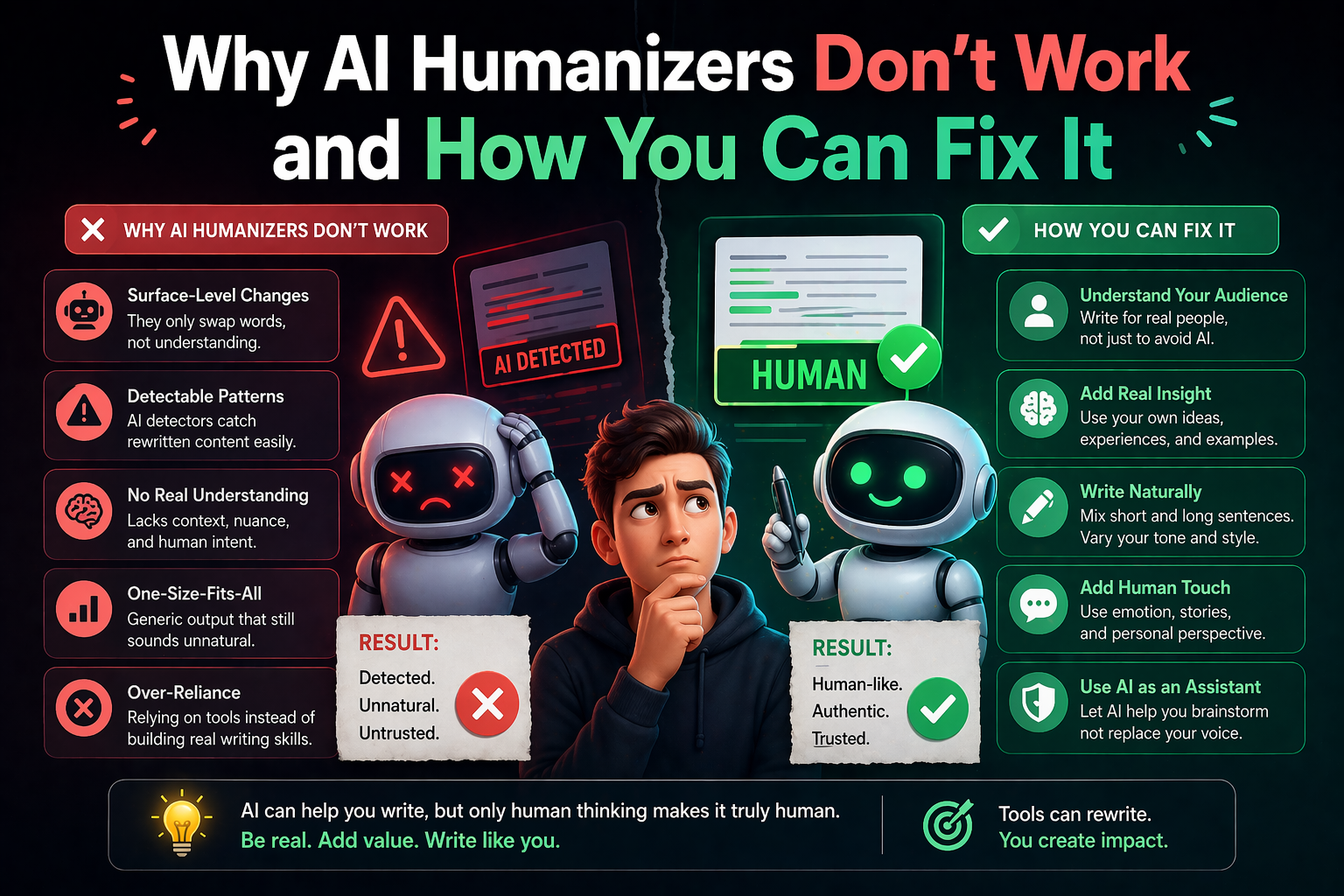
Why AI Humanizers Don’t Work and How You Can Fix It
Have you ever spent hours perfecting your content, only to have it flagged by tools like Turnitin? It’s a frustrating experience that makes many creators doubt the worth of automation tools. It feels like you’re up against advanced algorithms that can spot machine-generated content.

Most digital rewriting tools fail because they lack real human thinking. They swap words but keep the same structure, making it easy for scanners to spot. Even after using these tools, your text can still be seen as 87% machine-generated. True quality comes from changing how you write.
We’re here to help you save time without losing your unique voice. By understanding what current technology can’t do, you can overcome these challenges. You’ll produce real results that pass every test.
Key Takeaways
- Most automated rewriting tools fail to bypass modern detection software like Turnitin.
- The primary issue is a lack of structural variation and authentic human logic.
- Content can still be flagged at high percentages even after using standard rewriting services.
- Relying on basic software often creates more work rather than saving you time.
- Mastering manual editing techniques is the most reliable way to ensure your content remains undetectable.
The Mechanics of AI Content Generation
To understand writing, you need to know how artificial intelligence works. Many think these tools are creative like humans, but they’re not. They use complex math, not real inspiration.
Understanding Large Language Model Patterns
Large language models look at huge datasets to find patterns. They use machine learning to see how words and ideas connect. They don’t “know” things; they just see how people usually think.
When you ask a model something, it looks for the most likely answer. This makes its writing very consistent but not as creative as humans. It always chooses the safest option, staying close to the average.
The Statistical Nature of Predictive Text
Every piece of AI writing is based on one simple idea: guessing the next word. This statistical signature is why AI writing is so easy to spot. It’s like a high-stakes game of guessing with every sentence.
“The danger is not that computers will begin to think like humans, but that humans will begin to think like computers.”
— Sydney J. Harris
The technology aims to avoid risks, so it doesn’t take big chances in writing. It sticks to what’s average, making its output a mirror of common human speech. Knowing this can help you find your own voice and go beyond what AI can do.
Why AI Humanizers Don’t Work in Practice
Ever wondered why your AI text still sounds robotic after using a “humanizer”? You’re not alone. Many business owners use these tools to avoid detection. But, they often struggle with challenges when the results don’t connect with readers. To understand why ai humanizers don’t work, we need to look at how they interact with content generation technology.
The Illusion of Perplexity and Burstiness
Detection software checks two main things: perplexity and burstiness. Perplexity measures how surprised a model is by the next word. Burstiness looks at sentence structure and length variation. Most humanization tools try to change these by adding complex words or varying sentence lengths.
But, this method doesn’t grasp the essence of machine learning. These tools lack real context understanding. So, they can’t mimic human thought’s natural flow. They just apply a formula that detectors can spot as fake.
Why Surface-Level Rewriting Fails Detection
These tools mainly swap common words with less common ones. They change AI output to trick systems. But, this superficial swap doesn’t change the text’s underlying structure.
The content still feels predictable to smart algorithms. It’s like painting a broken engine. It might look different at first, but its mechanical nature is clear to anyone who reads it.
The Loss of Semantic Integrity
When you focus on avoiding detection over clarity, your message quality suffers. These tools often insert complex words where they don’t fit. This causes a loss of semantic integrity, making the message unclear or lost.
Your audience wants clear, useful information most. When your writing becomes awkward or formal due to humanization, you lose their trust. These challenges show that creating real, human-led content is the only way to truly connect.
Identifying the Core Limitations of Automated Humanization
If you’re asking why AI humanizers don’t work, it’s because they can’t truly capture human feelings. These tools try to hide their artificial nature but often fail. They don’t change the real structure of your writing.
Today’s detectors, like GPTZero, are very smart. They look at sentence patterns, word choices, and style to spot fake text. Using these tools just hides the problem, not solves it.
Syntactic Predictability vs. Human Nuance
Human writing is all about surprise and variety. We change sentence lengths and styles to keep readers interested.
But AI tools can’t do this well. They stick to patterns and sound stiff and mechanical. This makes the text seem fake.
The Failure to Capture Domain-Specific Expertise
AI tools can’t really understand deep, special knowledge. They might sound like an expert, but they lack real experience.
True expertise comes from doing the job for years and having unique data. AI can’t match this level of insight.
Why Generic Tone Adjustments Sound Artificial
Many tools try to make AI writing sound more natural by changing words or tone. But this usually ends up sounding forced and unnatural.
These changes don’t fit your brand’s voice or your audience’s needs. The result is confusing and awkward.
| Feature | Automated Humanization | Manual Human Editing |
|---|---|---|
| Sentence Rhythm | Predictable and uniform | Varied and engaging |
| Domain Expertise | Surface-level mimicry | Deep, accurate insights |
| Brand Voice | Generic and inconsistent | Authentic and tailored |
| Detection Risk | High probability of flagging | Low probability of flagging |
Establishing a Foundation for Authentic Content
Your brand voice is the core of your online presence. It needs your direct input to connect with your audience. Using default settings can lead to generic content that misses your business’s unique touch. By taking charge of the creative process, you make sure every piece of content shows your professional side.
True humanization means changing how you use your tools. Instead of seeing AI as a magic solution, treat it as a junior assistant. It needs clear instructions to match your style and values.
Defining Your Unique Brand Voice
Being consistent is key to a professional brand. You must decide on the tone, words, and view that represent your business before creating content. This foundation keeps AI from sounding robotic or too formal.
“Authenticity is not a feature you can toggle on; it is the deliberate alignment of your core values with every word you publish.”
To set this up, think about these points:
- Vocabulary: Pick the specific industry terms you use and those you avoid.
- Sentence Structure: Choose if your brand likes short, direct sentences or longer, more detailed ones.
- Perspective: Figure out if you speak as a peer, mentor, or direct service provider.
The Role of Subject Matter Expertise in Prompting
Your deep knowledge is key in humanization. AI has lots of general data but lacks your specific, real-world insights. When you add your expertise to prompts, you turn generic text into authoritative content.
Begin by giving AI specific rules and context. Tell it who your audience is and what problem you’re solving today. By guiding AI with your insights, you keep control over your message while using automation’s speed.
This teamwork makes sure your content stays consistent and authoritative everywhere. You’re not just writing text; you’re sharing your unique view with more people, keeping it personal.
Refining Your Prompt Engineering Strategy
To get better results from AI, treat it as a collaborative partner, not just a search engine. Many struggle with generic outputs because they give vague, one-sentence commands. By changing how you approach it, you can cut down on the need for manual editing.
Moving Beyond Basic Instructions
High-quality output comes from detailed instructions. Instead of asking for a simple blog post, give the AI a clear goal, target audience, and format. Define the tone and the problem you want to solve for your reader.
Think of your prompt as a briefing for a freelance writer. The more you tell the AI about your brand, the less likely it is to use robotic, predictable patterns. Clear, structured guidance keeps the machine focused and in line with your goals.
Incorporating Contextual Constraints
Context keeps your content specific and relevant. By setting specific constraints, you ensure the AI focuses on relevance and accuracy over randomness. For example, asking for real-world examples forces the model to use specific scenarios.
You can also limit sentence structure, vocabulary, or data points. This approach increases the quality of the final draft. It prevents the model from using filler phrases that detection tools often flag.
Using Persona-Based Prompting Techniques
Assigning a persona to your AI is very effective. When you tell the AI to act as an industry expert or consultant, it changes its tone. This simple trick makes the model sound more authoritative and nuanced.
Try saying, “Act as a professional copywriter with ten years of experience in the tech industry.” This instruction changes the model’s statistical weights. It leads to content that feels more deliberate and less like a machine response.
Integrating Personal Anecdotes and Real-World Data
Your unique perspective is key to beating automated content. Software can follow patterns, but it can’t match the emotional weight of your life. Knowing these limitations is the first step to making content that really connects with your audience.
The Importance of First-Hand Experience
Real-life experiences block generic, AI-made text. Adding your own stories to your writing gives context AI can’t offer. This turns a regular article into a compelling narrative that earns trust right away.
- Share specific challenges you faced in your business.
- Describe the exact moment you discovered a solution.
- Include sensory details that make your story feel tangible.
Injecting Proprietary Data into AI Outputs
Your own data is a treasure that makes your content stand out. Using your case studies, unique metrics, or research in your writing adds depth. This authority is hard for generic models to match.
Here’s how to use your data:
- Use your own customer success stories to illustrate a point.
- Include internal survey results to back up your claims.
- Reference specific industry benchmarks you have tracked over time.
Balancing Automation with Human Insight
The aim is not to ditch tech, but to use it to support your expertise. Good automation handles the basics and research, while you add the human touch. This mix keeps your brand voice consistent yet personal.
You should always review and edit AI drafts. Check for emotional resonance and facts. This ensures quality without losing efficiency. It lets you produce more content while keeping it authentic.
Structural Editing for Natural Flow
Rhythm is key to making human writing stand out. AI can write correct sentences but lacks a natural flow. To make your content unique, you need to refine it by hand.
Breaking the Monotony of AI Sentence Length
AI sentences often have the same length, making reading dull. This uniformity is a sign of machine writing. It can make your audience lose interest fast.
Try mixing short and long sentences. Short sentences give readers a break, while long ones build your argument. This mix creates a natural flow that feels human.
Improving Transitions Between Complex Ideas
AI can struggle to connect ideas smoothly. It might jump between points without clear links. Look for these gaps when editing.
Use transition words to connect ideas. Words like “consequently” or “in contrast” help readers see the link. Thoughtful transitions make your writing flow well, not feel like a list.
Applying Manual Rhythm and Pacing Adjustments
Read your content aloud to check the flow. This method helps spot pacing issues. If you stumble, so will your readers.
Don’t hesitate to rewrite for a better flow. Manual adjustments add your voice and emphasis. This makes your writing resonate with your audience.
Ethical Considerations in AI Content Creation
When you use artificial intelligence every day, ethics are as crucial as the tech itself. The tools you have are powerful, but you must use them wisely. This ensures your brand stays trustworthy. Tackling ethical concerns early helps avoid problems later and builds trust with your audience.
Transparency and Disclosure Requirements
Being honest about your machine learning use is key for a professional image. Your customers value truth and appreciate knowing when tech helps create content. Being clear about this builds trust and shows your commitment to being real.
It’s not hard to be transparent. Just add a note at the end of a blog or a quick mention in your newsletter. This small action helps build a strong, honest relationship with your readers.
Maintaining Accountability for AI-Generated Claims
Even with automation in content creation, you’re still in charge. AI can sometimes get things wrong, so checking everything is crucial. You must double-check every claim to keep your brand reliable and accurate.
“Technology is a useful servant but a dangerous master.”
Christian Lous Lange
Being accountable for your content means you’re responsible for every word’s accuracy. Never publish without a careful review. This accountability keeps your reputation strong and makes your business a trusted source in your field.
Navigating the Balance Between Efficiency and Integrity
Finding the right balance between fast automation and high standards is the real challenge. It’s easy to want to go fast, but sacrificing quality can hurt your growth. Always keep your core values in mind, even when you’re in a hurry.
By focusing on integrity, you turn your AI workflow into a strength. Treating tech as a partner, not a replacement, makes your content both efficient and meaningful. This balanced approach is essential for lasting success in today’s digital world.
Advanced Techniques for Manual Polishing
Manual polishing connects raw machine output with genuine reader connection. Modern technology is fast but lacks the human touch. Treat your draft as a starting point, not a finished product, to ensure your message resonates.

Identifying and Removing Robotic Phrasing
AI often struggles with brevity, showing in texts under 300 words. In these cases, AI’s repetitive patterns stand out. Look for overly formal transitions and repetitive sentence structures that lack human touch.
AI tends to use “filler” adjectives that add length without meaning. Remove these to reveal the core message. Tightening your phrasing makes the content feel more direct and intentional.
Adding Idiomatic Expressions and Cultural Context
Language reflects shared experiences. To make your writing authentic, include idioms or regional phrases that resonate with your audience. This cultural context turns generic content into something written by a real person.
Use these expressions wisely to avoid distraction. Anchor your points in familiar reality. This approach strengthens your connection with readers.
Reviewing for Emotional Resonance
The final step is checking for emotional depth. Ask if the text conveys the intended feeling or feels cold. If it’s cold, add a personal anecdote or a rhetorical question to engage the reader.
Ignoring a flat, robotic tone can harm engagement. Always prioritize the human experience over efficiency. Addressing ethical concerns by being transparent and genuine keeps your content trustworthy and effective.
Testing Your Content Against Quality Benchmarks
Quality control is key in mastering AI-assisted writing. Before publishing, test your content against quality standards. This ensures it meets your goals. Understanding your content’s limitations helps refine it into something impactful.
Evaluating Readability and Engagement Metrics
To see if your content connects with your audience, look beyond word counts. Use tools like the Flesch-Kincaid grade level to check if it’s accessible. High engagement shows your content balances tech implications with a human touch.
Watch how long readers stay on your page. If they leave fast, your content might lack depth or emotional connection. Always prioritize clarity to keep readers engaged from start to finish.
Iterative Feedback Loops for Continuous Improvement
Creating a feedback loop is the best way to improve your AI collaboration. Reviewing your data helps spot ethical concerns and adjust your strategy. This leads to data-driven decisions that boost your content strategy.
Seeing every piece of content as a learning chance helps you overcome automated tool limitations. Your ability to spot implications in your writing gets better with each try. This keeps your brand voice consistent and real.
Also, be aware of the ethical concerns in digital publishing. Being accountable for your claims builds trust with readers. Continuous improvement is essential for a sustainable and successful content business.
Conclusion
Using automated tools for writing often results in generic content that doesn’t connect with your audience. You have the power to improve your brand by combining human insight with AI’s speed.
Your unique perspective and real-world experience give you authority. By focusing on your voice, you build trust with your readers. This way, you use AI to grow your business.
Begin by improving your prompts and adding a personal touch to every draft. This ensures your message stands out in a busy online world. Your expertise is something no software can match.
Take charge of your content today to create something that truly resonates. By keeping your human touch central, you can succeed. Start writing with purpose and watch your engagement soar.
FAQ
Why do AI humanizers often fail to bypass sophisticated detection software like Turnitin or Copyleaks?
Most tools fail because they only swap synonyms. They don’t change the text’s structure. Modern detection systems look for AI’s unique patterns. Changing words like “use” to “utilize” doesn’t fool them.
What are the primary technical challenges that make “humanized” content easy to spot?
The main issues are perplexity and burstiness. Perplexity is about word randomness, and burstiness is about sentence structure. AI content is too consistent, lacking the natural flow of human writing.
Can generic tone adjustments fix the limitations of automated content?
No. Automated tools can’t capture specific expertise. Using a “friendly” or “professional” filter makes content sound fake. True humanization needs the unique insights of a real expert.
How does the statistical nature of predictive text affect my brand’s credibility?
Tools like ChatGPT predict words based on patterns. This makes your message seem bland and untrustworthy. For a small business, this can harm your brand’s authority.
What role does prompt engineering play in creating more authentic AI drafts?
Good prompt engineering is key. Instead of asking for a generic blog, give specific instructions. Tell the AI to write like a project manager using Asana for more human-like content.
Why is injecting proprietary data more effective than using a humanizing tool?
AI can’t replicate personal data or stories. Using your own experiences creates unique value. This is the best way to connect with your audience while avoiding detection.
How can I manually adjust the rhythm and pacing of AI-generated text?
Vary sentence lengths to break the monotony. AI prefers medium-length sentences. Mix short, punchy sentences with longer ones to mimic human speech.
What are the ethical concerns regarding the use of AI in professional content creation?
The big concerns are transparency and accountability. Automation helps scale, but you’re still responsible for accuracy. Not disclosing AI data can damage your integrity, crucial in fields like law or medicine.
How do idiomatic expressions and cultural context help in bypassing detection?
AI struggles with local references and idioms. Adding metaphors or phrases specific to your area or industry adds emotional resonance. This makes your content sound human-written.
Is it possible to achieve 100% human-like content using only software?
No, not yet. AI is a great helper but can’t replace human judgment. The best strategies use AI for drafting, with a human expert for strategy, voice, and verification.
