
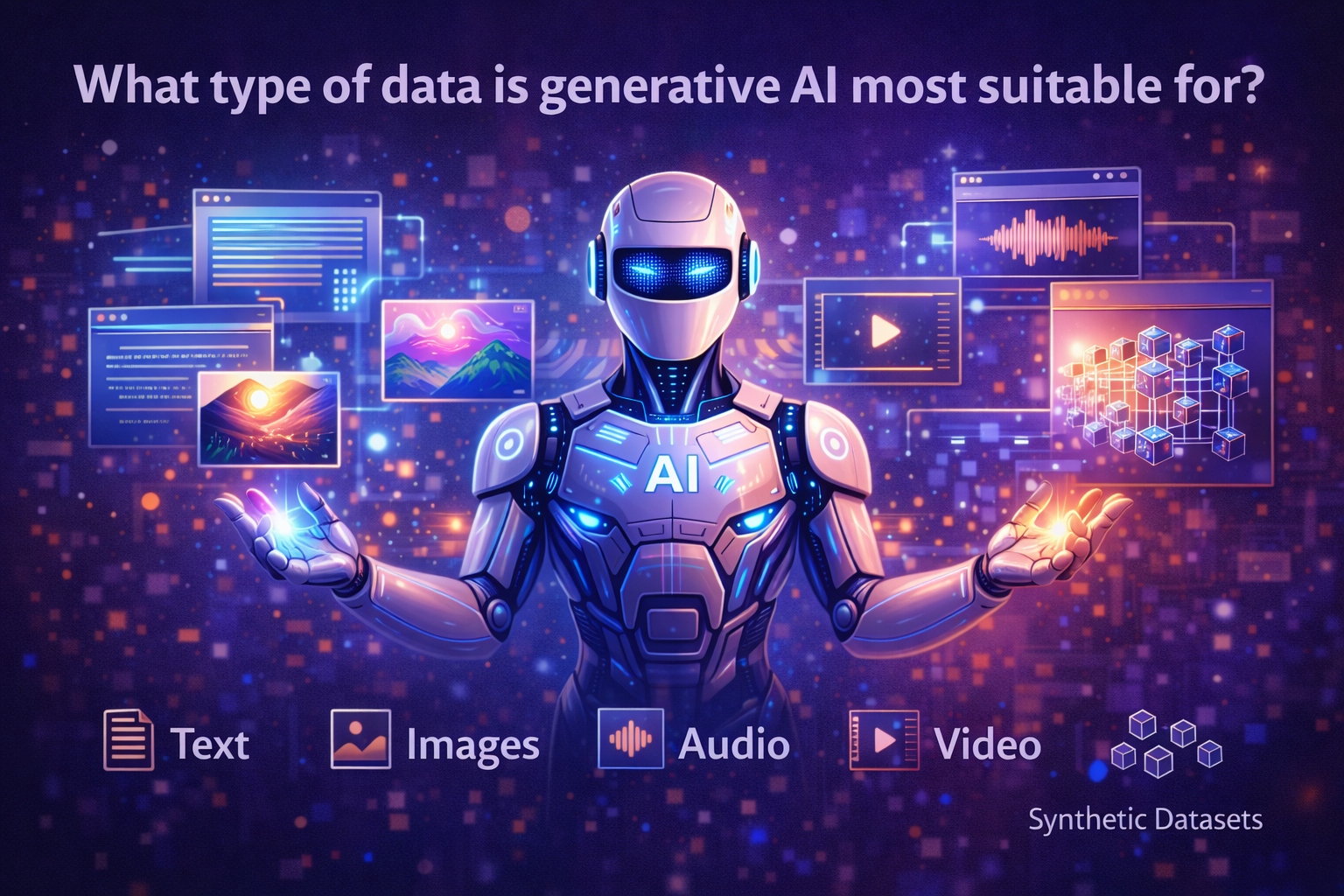
What type of data is generative ai most suitable for
Ever wondered why some automation projects fly high while others hit a wall? It’s not always the software’s fault. It’s more about the data you give it. Knowing what type of data is generative AI most suitable for is key to your business’s success.

Generative models do best with rich, high-dimensional information. They’re great at spotting complex patterns that we might overlook. By using inputs with deep context, you can create original, human-like content that adds real value.
We think making these technical needs clear helps you compete better. When you pick the right inputs, you turn simple numbers into powerful business assets. Let’s dive into how to match your resources with the right tech for real results.
Key Takeaways
- Generative models perform best with high-dimensional and complex datasets.
- Success depends on the quality and depth of the information provided.
- These tools go beyond simple analysis to create original, context-aware content.
- Identifying the right input is the first step toward effective automation.
- Small businesses can leverage these patterns to gain a competitive edge.
Understanding the Core Capabilities of Generative AI
The secret to successful generative artificial intelligence data applications is how they process information. Unlike old software, generative AI finds patterns in your data to make something new.
Imagine a student learning a language to write a novel. The model analyzes lots of data to understand the language’s structure and tone. This lets it create text, images, or audio that seem remarkably authentic and fit your needs.
The quality of your data affects the AI’s output. Bad data means bad results. Clean, high-quality data is key for generative artificial intelligence data applications to help your business grow.
Let’s look at how these methods differ in everyday use:
| Feature | Traditional Analytical Models | Generative AI Models |
|---|---|---|
| Primary Goal | Classification and Prediction | Creation and Synthesis |
| Data Usage | Labels and Structured Fields | Patterns and Underlying Structures |
| Output Type | Numerical Scores or Categories | Novel Content (Text, Image, Audio) |
| Business Value | Efficiency in Reporting | Innovation in Content Generation |
These core abilities let you automate complex tasks that took hours. Whether it’s writing marketing copy or designing prototypes, the tech helps you do more with less. Focusing on your data quality is crucial for getting the best from your AI tools.
What Type of Data Is Generative AI Most Suitable For in Modern Enterprises
Your business creates a lot of data every day. Most of it is messy and unorganized. It includes emails, chat logs, and meeting notes that don’t fit into spreadsheets.
When you ask what type of data is generative ai most suitable for, the answer is clear. It’s the unstructured data that traditional databases can’t handle. They can’t understand the tone of a complaint or the main idea of a proposal.
Generative AI changes this by turning messy data into useful insights. It uses generative ai data analysis to go beyond simple reports. Now, you can create new content, automate tasks, and make better decisions.
“The most valuable asset in your enterprise is not the data you have organized, but the hidden knowledge buried within your unstructured communications.”
— Industry Insight
Your data is like a goldmine for growth. By using generative ai data analysis on diverse sources, your team can save time. Knowing what type of data is generative ai most suitable for lets you turn chaos into a strategic advantage.
Unstructured Text Data and Natural Language Processing
Most of the data your business makes every day is not in neat rows and columns. This includes emails, chat logs, memos, and code files. Generative ai data use cases help turn this messy data into a powerful tool for growth.
Natural language processing connects raw text to useful business insights. It lets machines grasp context, emotion, and intent well. By training models on your business talks, you create systems that sound like your brand.
Analyzing Customer Sentiment and Feedback Loops
Your customers share what they need, but this feedback is often hidden in many support tickets. Manual review is too slow for today’s fast business world. Advanced AI quickly sorts feedback and finds common issues.
This makes subjective comments into clear data. You can see how opinions change over time. This lets you adjust your plans before small problems grow big. These generative ai data use cases help you hear your audience better, making sure everyone is heard.
Automating Documentation and Technical Writing
Technical writing takes up a lot of time that could be used for new ideas. Now, you can easily make manuals, reports, and procedures. By using AI, the system learns your writing style and words.
This leads to consistent, professional documents that match your brand. Automation cuts down on mistakes and keeps your knowledge base up-to-date without manual updates. Using these generative ai data use cases lets your team focus on big plans while AI handles the details.
Visual Data and Generative Image Synthesis
Now, you can use generative artificial intelligence to change how you see visuals. These systems study lots of images to learn about their structure, style, and layout. This lets you create top-notch artwork and designs that match your brand perfectly.
Applications in Product Design and Prototyping
Creating prototypes fast is now possible for everyone, not just big companies. AI lets you try out different product ideas in minutes, not weeks. You can see how a product might look before making it real.
This makes design more accessible. You can try out many design ideas quickly. It lowers the chance of mistakes in production. It’s like using data to turn a simple idea into a real product.
Enhancing Marketing Assets with Synthetic Media
Making great marketing materials used to be expensive and time-consuming. But now, you can create stunning visuals that show off your brand’s vibe easily. These AI tools help you make consistent images that speak to your audience in India and worldwide.
Need photos for social media or custom illustrations for your site? AI is a cost-effective way to do it. You get to control the creative process while saving time and money. Here’s how AI changes your work:
| Feature | Traditional Design | AI-Assisted Design |
|---|---|---|
| Production Time | Days or Weeks | Minutes or Hours |
| Cost per Asset | High (Studio/Labor) | Low (Subscription/Compute) |
| Scalability | Limited by Resources | Highly Scalable |
| Customization | Manual Editing | Automated Iteration |
Source Code and Programming Language Data
Now, you can change how you make software with generative ai data modeling. AI works with code like a pro, making hard tasks easy. Even if you’re not a pro coder, these tools help you manage projects with ease.
Accelerating Software Development Cycles
Generative AI is great at writing code, learning from lots of software. It automates the boring parts, so you can focus on the fun stuff. This means you spend less time on errors and more on making cool apps.
Using AI, you can go from idea to working app fast. This makes your development process quicker and helps you stay ahead in the market.
Legacy Code Refactoring and Documentation
Working with old systems can be tough, but AI makes it easier. It helps clean up old code and explains tricky scripts. This means you can keep your systems running smoothly without a huge team.
With generative ai data modeling, you can keep your code up to date. This keeps your business flexible and safe. Here’s how AI changes the game for programming tasks.
| Task Type | Manual Approach | AI-Assisted Approach |
|---|---|---|
| Code Generation | Time-consuming manual typing | Instant snippet creation |
| Bug Detection | Slow, manual debugging | Real-time pattern analysis |
| Documentation | Often neglected or outdated | Automated, accurate summaries |
| Refactoring | High risk of breaking logic | Safe, guided optimization |
Using these smart tools, you can save time and grow your business. Whether you’re starting a new project or updating an old one, smart automation is key to success.
Tabular Data and Synthetic Dataset Generation
You might think your spreadsheets are too rigid for AI, but generative AI data synthesis is changing that. While many think AI is only for creative writing or art, it can also handle structured data. This includes the rows and columns in your Excel sheets or SQL databases.
These tools let you fill in missing data or create test environments. You can try out business simulations without using real data. This is a powerful way to keep data safe while improving your analysis.

Privacy-Preserving Data Augmentation
Keeping customer privacy is crucial today. When sharing datasets, generative ai data generation creates synthetic versions. These versions have the same statistical properties as the real data.
Since these records don’t have personal info, you can innovate safely. Your team can test new features or build reports without risking customer data. This keeps your customers’ sensitive information secure and private.
Addressing Class Imbalance in Machine Learning Models
Dealing with skewed data is a big challenge in predictive modeling. If your dataset lacks examples of a specific outcome, models won’t work well.
Generative ai data synthesis helps by adding more examples of underrepresented classes. This makes your predictive tools robust and fair. It leads to more reliable simulations and better business decisions.
Audio and Speech Data Processing
Using audio and speech data can create strong bonds with your customers. It includes spoken words, podcasts, and music, offering a deep well for innovative AI models. By studying these sounds, you can make outputs that seem real and engaging.
This field has grown fast, moving from robotic sounds to natural-sounding interactions. It helps both small and big businesses save time and keep service quality high.
Voice Synthesis for Personalized Customer Experiences
Voice synthesis lets you send custom messages that connect with your audience. You can avoid generic recordings and create audio that fits each customer’s situation. This personalization at scale keeps your brand voice the same everywhere.
Think about automated support that sounds welcoming and helpful, no matter how many questions you get. Advanced speech synthesis can make virtual assistants that help users easily. This builds trust and keeps customers coming back.
Transcription and Translation Workflows
AI can make your meetings, training, and brainstorming calls into text quickly. This boosts productivity by letting your team focus on tasks, not taking notes.
Also, translation tools remove language barriers, making your content global. You can quickly translate a video into many languages, keeping everyone informed. Here’s how these tools compare in business:
| Feature | Primary Benefit | Business Impact |
|---|---|---|
| Voice Synthesis | Personalized Engagement | Higher Customer Loyalty |
| Automated Transcription | Time Efficiency | Faster Decision Making |
| Real-time Translation | Global Reach | Expanded Market Access |
Multimodal Data Integration and Cross-Domain Learning
Multimodal learning is the next big thing for companies wanting to use generative ai data-driven solutions. It combines text, images, and audio to reveal deeper insights. This way, your systems can handle and connect different types of data at once, just like we do.
Bridging Text and Image for Enhanced Search
Traditional search tools often fail when looking for info based on visuals. By mixing text and image data, you can make search better. This is great for e-commerce in India to help customers find what they need.
Your AI can link an image to a product description or manual. This means users can search naturally while the system checks your visual library. It connects what customers see with what they need to know.
Contextual Understanding in Complex Decision Support
Business decisions usually need more than one piece of data. Multimodal AI can combine different data types for a holistic view. This is useful for analyzing market trends or internal risks.
These systems look at financial reports, site inspections, and audio feedback. Using generative ai data-driven solutions, you make decisions based on solid evidence, not guesses. Here’s how multimodal AI beats single-mode systems.
| Feature | Traditional AI | Multimodal AI |
|---|---|---|
| Data Scope | Single format (Text only) | Integrated (Text, Image, Audio) |
| Context Depth | Limited to one dimension | Comprehensive and situational |
| Decision Quality | Basic pattern matching | Strategic and nuanced |
| User Experience | Rigid and keyword-based | Intuitive and conversational |
Case Study: Financial Services and Risk Modeling
In the world of banking, your data strategy is key to success. Banks must predict market changes and follow strict laws. Generative ai data use cases help them go beyond old data to see the future.

Synthesizing Market Scenarios for Stress Testing
Old stress tests use limited data and miss big surprises. Generative AI creates many future market scenarios. This generative ai data modeling lets you test your portfolio against big changes.
“The ability to simulate synthetic market conditions is not just a technical upgrade; it is a fundamental shift in how we perceive and mitigate systemic financial risk.”
AI makes fake market scenarios. This lets your team find problems before they happen. Your money stays safe, even when the economy is bad.
Automating Regulatory Compliance Reporting
Reporting for rules is very hard, taking up lots of time. Intelligent automation makes it easy and mistake-free. AI helps sort and format data for new rules.
Using these tools has big benefits:
- Drastic reduction in manual labor, freeing up your staff for important work.
- Enhanced accuracy by cutting down on mistakes in data.
- Real-time updates that keep reports current with laws.
These generative ai data use cases help banks stay compliant and flexible. With generative ai data modeling, your company can do well in a strict world and save money.
Case Study: Healthcare and Medical Imaging
Imagine a world where medical research moves faster without risking patient privacy. The healthcare sector is changing fast. Providers are using new tools to handle complex information better.
Clinics and research facilities are improving outcomes. They do this while keeping data safe and secure.
Generating Synthetic Patient Records for Research
Medical research faces a big challenge: finding quality data. Privacy laws make it hard to share real patient info. Generative ai data generation creates fake data that looks real but keeps identities safe.
This fake data lets scientists test ideas safely. It’s entirely artificial, so there’s no risk of privacy breaches. This helps researchers work together, speeding up discoveries in areas like cancer and rare diseases.
Assisting Diagnostic Imaging Interpretation
Technology is helping doctors too. Generative ai data synthesis spots problems in scans like X-rays and MRIs. It doesn’t replace doctors but helps them by pointing out things they might miss.
These tools give doctors a second opinion. They help reduce mistakes and make treatments faster. When doctors and AI work together, care becomes more efficient and focused on the patient.
The table below shows how these new methods compare to old ways.
| Feature | Traditional Workflow | AI-Assisted Workflow |
|---|---|---|
| Data Privacy | High risk of exposure | Zero risk (synthetic data) |
| Diagnostic Speed | Manual review required | Automated pre-screening |
| Research Scope | Limited by consent | Unlimited, scalable datasets |
| Accuracy | Human-dependent | Human-AI collaboration |
Challenges and Ethical Considerations in Data Selection
Building generative ai data-driven solutions starts with high-quality input data. It’s crucial to think about the ethics of your data choices. This ensures your tools are fair and open to everyone. A no-nonsense approach to managing data helps avoid risks and boosts your tech’s potential.
Mitigating Bias in Training Datasets
Quality training data is key for reliable models. If your data lacks diversity, your AI might not reflect reality. You need to create diverse and representative datasets for fair and balanced results.
Regular checks on your training data can spot bias early. Being open about where your data comes from builds trust. Remember, a model’s quality depends on the data it learns from.
Ensuring Data Privacy and Security Compliance
Working with sensitive data means strict security rules. When using generative ai data-driven solutions, protect private data from misuse. This is key for keeping your brand’s good name.
Use strong encryption and anonymization to keep data safe. Make sure your data handling meets local and global privacy laws. These essential steps let your business innovate safely and respect privacy.
Conclusion
Generative AI is a powerful tool for growing your business. Its success relies on the quality and variety of data you use. By choosing the right data, you unlock its full potential.
Begin by finding areas where AI can make a big difference right away. Start with small projects to test and improve your workflows. This helps you build confidence and learn to use data more effectively.
As you grow, remember to keep ethical practices in mind. Protecting user privacy and being transparent builds trust with your customers. These values help your brand stay ahead in the digital world.
You have the power to change your daily work with these tools. Start today to save time and focus on what’s important. Your journey to smarter success starts with one well-thought-out action.
FAQ
What type of data is generative ai most suitable for when starting a small business project?
Generative AI works best with unstructured data like text, images, and audio. It’s not just for sorting spreadsheets. Tools like ChatGPT or Midjourney can create original content for your business.They help you make marketing emails and custom visuals that connect with your audience.
What are the most common generative artificial intelligence data applications for solopreneurs?
Solopreneurs find AI tools useful for automation and creative help. Tools like Jasper help write blog posts fast. Descript edits podcast audio with text, and Adobe Firefly makes marketing assets.These tools let you work like a big creative agency without the high costs.
Can you provide practical generative ai data use cases for operational efficiency?
Sure. AI can automate customer support, summarize legal contracts, and even write code for your site. By using your business data, AI can handle routine tasks.This keeps your brand’s voice and standards while saving time.
How does generative ai data analysis differ from traditional business reporting?
Traditional analysis looks back to tell you what happened. Generative AI looks at data to predict and create. It can analyze customer feedback to understand trends and suggest solutions.This way, AI helps you see the “why” behind data and offers plans to improve.
Why is generative ai data synthesis important for data privacy?
Generative AI synthesis creates fake data that looks real but keeps personal info safe. It’s great for testing tools or sharing data without risking privacy. This helps you follow data privacy laws while still using data insights.
How can generative ai data generation help with machine learning models?
Generative AI solves the problem of “thin” data. It fills gaps in data for training models. For example, it can create scenarios for stock shortage prediction, making your system more accurate.
What role does generative ai data modeling play in long-term business strategy?
Generative AI modeling lets you test “what-if” scenarios for your business. It’s useful in finance and retail, simulating market conditions. This helps you test plans without real-world risks.It creates a digital version of your business for safe testing and quick improvement.
How do I begin implementing generative ai data-driven solutions without a technical background?
You don’t need coding skills to use generative AI. Most tools have easy interfaces. Start with a task like email responses or photo resizing.Look for AI tools that match your needs. Tools like Copy.ai or Canva can save you hours and boost your business without a big budget.
