
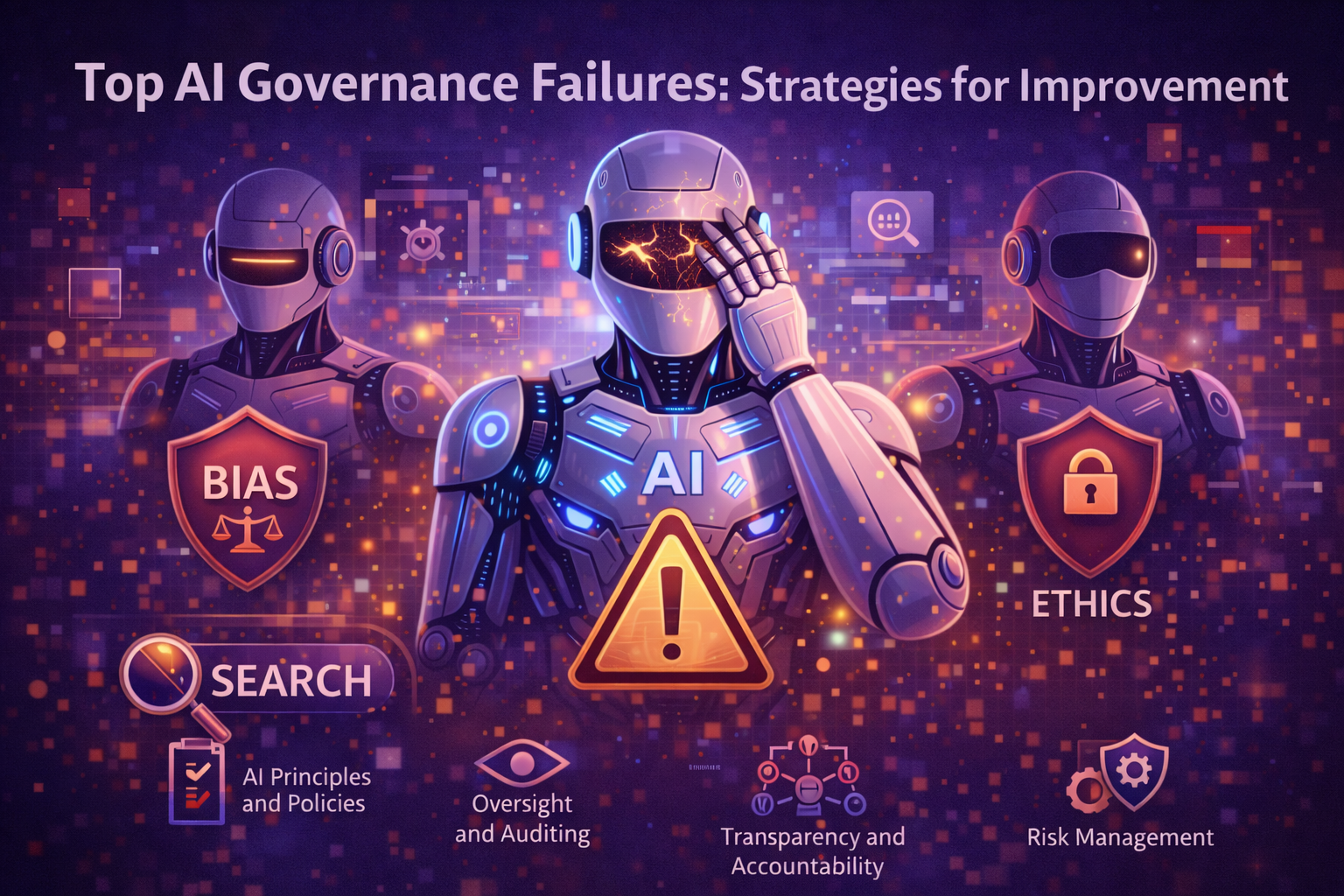
Top AI Governance Failures: Strategies for Improvement
Adopting new technology can feel like a race to stay ahead. For small business owners, the push to automate can overlook risks. Sadly, common ai governance failures can turn these tools into big problems for your company.
You don’t need a huge budget to keep your digital future safe. By seeing these systems as force multipliers for data risks, you can act early to protect your business. We aim to make these complex issues clear and offer a clear path to success.

You can start using strong, ethical, and secure practices today. Let’s dive into how to confidently and precisely navigate this complex world.
Key Takeaways
- Automated systems can make existing data security issues worse.
- Small businesses can have solid oversight without huge budgets.
- Planning ahead can avoid expensive mistakes with new tech.
- Following ethical standards is key to keeping customer trust.
- Security should be a core part of your strategy, not an afterthought.
Understanding the Landscape of AI Governance Failures
Many businesses jump into automation without a plan, leading to ai governance failures. They see these systems as just technical tools. But they work best with a solid operational framework. Governance is not just a formality; it’s the backbone that makes sure your tools work as you want.
Defining Governance in the Context of Machine Learning
In machine learning, governance is like a system of ownership and control. It stops your technology from becoming a problem. It needs clear rules on how models decide and who’s responsible for their actions. Without it, you can’t track performance or fix mistakes before they get worse.
Good governance gives you proof that your systems are trustworthy. It sets clear roles so every automated action meets your business goals. This makes artificial intelligence ethics a real, everyday part of your team’s work.
The Cost of Ignoring Ethical AI Development
Ignoring artificial intelligence ethics can hurt your reputation and lead to legal issues. If you don’t consider bias or transparency, you might lose customer trust. This loss of trust is often more costly than setting up proper safeguards early.
By focusing on ethical ai development from the start, you avoid common pitfalls. Investing in these standards now protects your brand and ensures growth. Embracing ethical ai development is not just about following rules; it’s about building a lasting future for your company.
Lack of Transparency in AI Decision-Making
When your software makes a big decision, knowing why is as important as the outcome. Keeping customer trust means explaining the reasons behind automated choices clearly. Without this, you risk ai governance failures that harm your reputation.
The Black Box Problem in Neural Networks
The “black box” issue happens when neural networks process lots of data in secret layers. These models are very powerful but hard to understand. It’s tough to check decisions or explain them to others.
Without seeing how data turns into decisions, you can’t spot mistakes or biases. This lack of transparency in ai decision-making is a big problem for businesses. It’s risky to use systems you can’t explain.
Strategies for Implementing Explainable AI (XAI)
To solve the problem, use Explainable AI (XAI) tools. These help show how different parts affect a decision. By making AI easier to understand, you can fix ai governance failures and be more accountable.
Here’s how XAI changes your work:
| Feature | Traditional Black Box | Explainable AI (XAI) |
|---|---|---|
| Decision Logic | Hidden/Opaque | Transparent/Auditable |
| Trust Level | Low | High |
| Regulatory Compliance | Difficult | Simplified |
| Error Detection | Reactive | Proactive |
Using these strategies makes your AI reliable and justifiable. You don’t need to be a data scientist to ask for clear AI. By choosing interpretable models, your team can make better decisions with confidence.
Inadequate Data Privacy Regulations and Compliance
Many businesses struggle with ai governance failures by overlooking data privacy. Handling sensitive user info is not just about data; it’s about trust. Neglecting these protections can harm your finances and reputation.
Paramount recently faced a $5M class-action lawsuit for sharing subscriber data without proper consent.
This shows that data privacy regulations are not just suggestions. They are strict laws that guide how you manage data in your AI models.
Navigating Global Data Protection Standards
The rules for data protection are complex and keep changing. To stay compliant, you need to know the rules in the places your users are from. Ignoring these rules can hurt your business.
Important rules to watch include:
- GDPR (General Data Protection Regulation): The top privacy law in the European Union.
- CCPA (California Consumer Privacy Act): Key for businesses in the United States.
- LGPD (General Data Protection Law): Main rule for working with Brazilian citizens.
Managing Personally Identifiable Information in Training Datasets
Your AI’s training data is crucial, but it often has personal info. If you don’t clean your data, you risk sharing personal info with the wrong people or even your AI.
To avoid these risks, you need strong data privacy regulations in your work. Here are key steps for handling personal info:
- Anonymization: Remove direct identifiers like names and email addresses from your data.
- Data Minimization: Only keep the data you really need for your model.
- Encryption: Protect your data with top encryption methods.
By following these steps, you protect your users and show you’re responsible. Respect the privacy of the people behind the data.
Failure to Establish Accountability in Machine Learning
Setting clear accountability is key to avoiding ai governance failures. When you use automated systems, make sure each decision has a clear owner. Without this, it’s hard to know who’s responsible for unexpected or biased results.
Defining Roles and Responsibilities for AI Teams
AI doesn’t manage itself. Accountability in machine learning means assigning roles to your team. This way, everyone knows their part in keeping the system working right.
Have a dedicated AI Ethics Officer for compliance and a Lead Data Scientist for model performance. This setup stops the “bystander effect,” where everyone waits for someone else to act. With clear roles, your team can quickly fix issues.
Creating Audit Trails for Algorithmic Decisions
Documentation is key to avoiding uncertainty. By keeping detailed audit trails for AI decisions, you can understand how AI outcomes are made. This transparency is crucial for showing you follow rules during checks.
Your audit trail should include data inputs, model versions, and decision parameters. This keeps your technology in check. It also helps you find and fix problems when ai governance failures happen.
| Role | Primary Responsibility | Governance Focus |
|---|---|---|
| AI Ethics Officer | Policy Enforcement | Bias Mitigation |
| Lead Data Scientist | Model Performance | Technical Accuracy |
| Compliance Manager | Regulatory Alignment | Audit Documentation |
Poor Risk Management in AI Implementations
Don’t ignore the dangers in your automated systems. Risk management in ai implementations helps spot problems before they hit your business. This way, you keep your brand safe and make sure your tech works right for your customers.
Identifying Bias and Fairness Risks
Bias can sneak into systems through the data they learn from. For example, a bank’s credit card system was found biased because it used old data that showed past unfairness. If your model learns from biased data, it will likely make the same unfair choices.
Checking your training data for representation gaps is key. If your data doesn’t show all kinds of people, your AI might make unfair choices. It’s important to keep checking your inputs to avoid ai governance failures that could lead to legal trouble.
Developing Robust Stress-Testing Protocols
After spotting risks, you need to test your models in different situations. Creating strong stress-testing protocols helps you see how your AI handles tough cases or unexpected data. This rigorous testing makes sure your systems work well, even when things change.
Think of stress testing as a “fire drill” for your algorithms. It lets you find errors before they affect your customers. Being proactive is the best way to avoid problems with automated systems and prevent ai governance failures.
| Risk Category | Mitigation Strategy | Expected Outcome |
|---|---|---|
| Data Bias | Diverse Dataset Auditing | Fairer Decisioning |
| Model Drift | Continuous Performance Monitoring | Consistent Accuracy |
| System Failure | Scenario Stress-Testing | Increased Reliability |
The Most Common AI Governance Failures in Enterprise
When you automate processes, you often expose existing data risks that were previously hidden. Many organizations mistakenly view artificial intelligence as a “set it and forget it” solution. This often leads to significant ai governance failures. By assuming that software can operate indefinitely without supervision, you leave your business vulnerable to systemic errors and security gaps.

Over-Reliance on Automated Systems Without Human Oversight
Relying entirely on algorithms to make high-stakes decisions is dangerous. Even the most advanced models can produce biased or incorrect outputs when they encounter edge cases. Human oversight acts as the essential safety net that catches these errors before they impact your customers or your bottom line.
To maintain control, you should implement a structured approach to your workflows:
- Establish clear thresholds for when an AI must escalate a decision to a human.
- Conduct regular audits of automated outputs to ensure they align with company values.
- Maintain broad visibility into data permissions to prevent unauthorized access.
Ignoring Long-Term Model Drift and Performance Degradation
Your AI models are not static assets; they are dynamic tools that require ongoing maintenance. Model drift occurs when the real-world data your system encounters begins to differ from the data used during its initial training. If you fail to monitor this shift, your AI’s performance will inevitably degrade over time.
Effective risk management in ai implementations requires you to treat model health as a priority. You must track performance metrics consistently to identify when a model is losing its accuracy. By staying vigilant and updating your training datasets, you ensure your tools continue to provide value without introducing hidden risks into your daily operations.
Building Effective Regulatory Frameworks for AI
Artificial intelligence is complex and needs a solid regulatory base. A structured environment encourages innovation and keeps things in check. It helps prevent ai governance failures and guides your team through the changing world of machine learning.
Aligning Internal Policies with External Legal Requirements
Your internal policies should connect your business goals with artificial intelligence ethics. Just following the law isn’t enough. You need to make these rules part of your daily work. This way, your data privacy regulations are not just rules, but a key part of how you develop products.
Begin by comparing your data handling with global standards. When your policies match legal expectations, you lower the risk of breaking the law. This makes following rules a strength, not a weakness.
Establishing Cross-Functional Governance Committees
To ensure accountability in machine learning, you need different views. A cross-functional committee brings together legal, technical, and business experts. This team is key for keeping transparency in ai decision-making throughout your company.
Singapore’s Model AI Governance Framework is a great example. It focuses on practical, people-focused solutions that you can tailor to your business. Your governance committee should include:
- Legal Counsel: To make sure everything follows data privacy laws.
- Technical Leads: To check how models work and handle bias.
- Business Stakeholders: To keep AI projects in line with company values and customer needs.
- Ethics Officers: To lead on artificial intelligence ethics and watch for societal impacts.
By setting up these roles, you make a clear plan for making decisions. This committee should meet often to check on model performance and update policies as technology changes. When you focus on ethics, you build a strong base for lasting success.
Technical Strategies for Ethical AI Development
Ethical AI development is more than just a belief; it’s about making technical choices. To keep data integrity strong, you can’t just rely on manual checks. By using specific technical tools, you can lower the risks of common ai governance failures.

Implementing Automated Bias Detection Tools
Automated bias detection tools are like a digital safety net for your AI projects. They scan your data and model outputs in real-time. This way, they catch unfairness before it affects your users.
It’s crucial to keep watching your data closely for privacy. These tools can spot if anonymized data is being traced back. Proactive detection helps keep your ethical AI promise, even as your data grows.
Standardizing Data Provenance and Lineage Tracking
Knowing where your data comes from is key to a clear system. Standardizing data provenance lets you track every piece of information back to its source. This is essential for fixing models and following new rules.
Lineage tracking shows how your data changes in the pipeline. Keeping a detailed record of these changes creates an audit trail. This shows your model’s trustworthiness. It gives you the confidence to grow your automation while staying true to your values.
Cultivating a Culture of Responsible Innovation
Your employees are your best defense against automated system risks. While tech safeguards are crucial, the human touch is key to ethical AI development. By creating a culture where your team gets the importance, you turn risks into strengths.
Training Staff on AI Ethics and Compliance
Education is the base for any good plan to avoid ai governance failures. Make sure every team member, from developers to managers, knows artificial intelligence ethics basics. This means more than just reading policies; it’s about interactive workshops that link theory to practice.
Training should show how data privacy regulations affect your work. When staff knows the reasons behind these rules, they’re more likely to stick to them. Knowledge is the best tool for compliance.
“The true measure of innovation is not just what we can build, but how we build it with integrity and respect for the individual.”
Encouraging Whistleblowing and Ethical Reporting
Even the most trained teams face unclear situations. You need a safe, non-punitive way for employees to share ai governance failures concerns. Without a clear way to report, small problems can grow into big risks.
To build this safety net, consider these steps:
- Set up an anonymous reporting portal for artificial intelligence ethics issues.
- Make it clear that reporting data privacy regulations breaches is protected.
- Encourage openness to show that ethical ai development is everyone’s job.
By making these talks normal, you shift from a culture of fear to one of collective accountability. This approach keeps your organization strong as you embrace new technologies.
Conclusion
Building a reliable business is more than just using the latest software. You must tackle ai governance failures to protect your reputation and customers. This ongoing effort keeps your operations ethical as your technology grows.
Start by adding strong ai regulatory frameworks to your daily work. These frameworks give you a clear plan for managing data and making algorithmic decisions. They make complex rules easy to follow in your business.
Good oversight is not a one-time task. It’s a habit that grows with your tools. By focusing on transparency and accountability, you lay a strong base for growth. Your early efforts prevent big mistakes and build trust with your audience.
Begin by checking your current policies. Small, steady improvements can lead to big success over time. Share your journey with your team to build a culture that values integrity most.
FAQ
What are the most common AI governance failures that small businesses face?
Small businesses often fail to manage AI properly. They treat AI as a tool to be forgotten. This leads to over-reliance on automated systems without human oversight.As a result, errors or model drift can happen. Model drift occurs when AI performance drops as data changes. Without accountability in machine learning, AI can become a problem, not a solution.
How can I ensure transparency in AI decision-making for my tools?
To ensure transparency in ai decision-making, use Explainable AI (XAI). This means using tools that explain AI’s decisions. For example, IBM Watson OpenScale helps understand AI choices.This way, you keep trust with customers and regulators.
Why is ethical AI development important for a business without a technical team?
Ethical AI development is key to avoid damage to your brand and legal issues. If AI makes biased decisions, like Amazon’s past tool, you could face big problems. Ethics keep your AI aligned with your values.
Which data privacy regulations should I be most concerned about?
You need to follow global rules like the General Data Protection Regulation (GDPR) in Europe and the California Consumer Privacy Act (CCPA) in the U.S. These data privacy regulations control how you handle personally identifiable information (PII).Ignoring these can lead to legal trouble and loss of trust from customers.
How do I implement risk management in AI implementations effectively?
Start by identifying risks before they affect your business. Use robust stress-testing protocols to test your models. This includes fairness checks and automated bias detection to spot problems early.
What is the best way to build regulatory frameworks for AI on a small budget?
You don’t need a big legal team to create regulatory frameworks for ai. Start with a small team that includes tech, legal, and business experts. This way, you can follow artificial intelligence ethics without spending a lot.
Can I automate the process of maintaining accountability in machine learning?
You can’t fully automate accountability, but you can help with it. Use standardizing data provenance and lineage tracking to track your data. Create audit trails for AI decisions to justify them if needed.
How can I train my staff to support our AI governance strategy?
Teach your team about data privacy regulations and ethical reporting. Encourage them to report any ai governance failures. This way, your team can protect transparency and accountability as you grow.
